
Degenerative Disc Disease Management
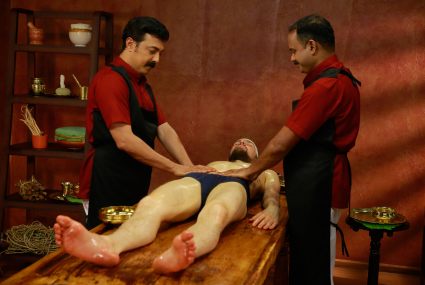
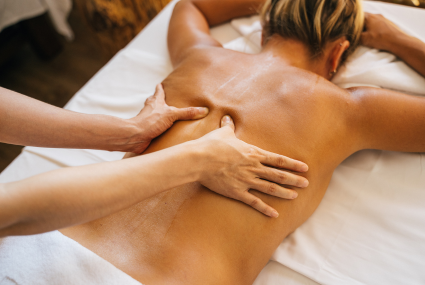
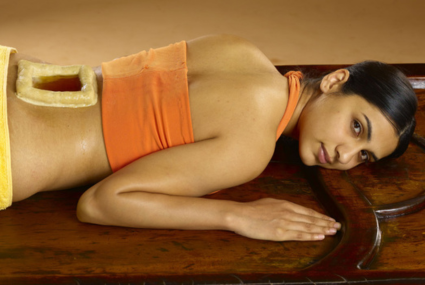
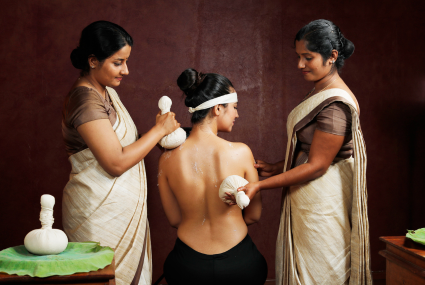
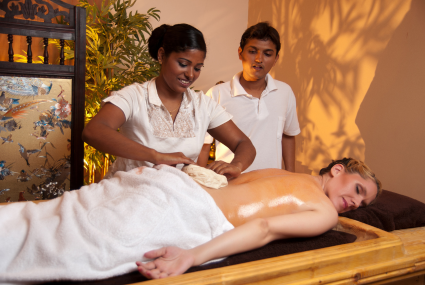
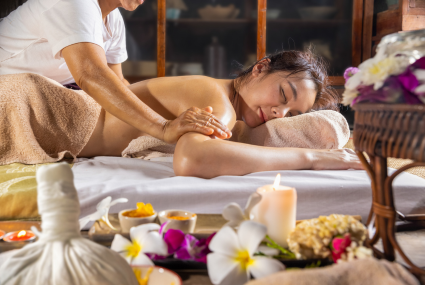
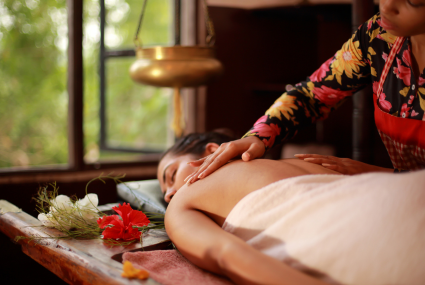
Degenerative Disc Disease (DDD) is a condition where the intervertebral discs lose their cushioning ability, leading to back pain, stiffness, and reduced mobility. Ayurveda considers DDD primarily a Vata imbalance, causing degeneration and dryness in spinal tissues. Treatment focuses on nourishing the spine using therapies like Abhyanga (medicated oil massage), Kati Basti (localised oil pooling), and Panchakarma therapy Basti (medicated enema) to restore disc health. Herbal formulations help regenerate tissues, while Rasayana therapies promote cellular rejuvenation. Additionally, yoga, tailored exercises, and dietary adjustments support spinal strength, flexibility, and long-term relief from degenerative changes
Intervertebral Disc Prolapse Treatment
Intervertebral Disc Prolapse (IVDP), commonly known as a slipped or herniated disc, occurs when the spinal disc bulges or ruptures, compressing nearby nerves and causing pain, numbness, or weakness. Ayurveda identifies this condition as an imbalance of Vata dosha. Treatment includes therapies like Abhyanga (medicated oil massage), Kati Basti (warm oil retention on the lower back), and Pancakarma therapy Basti (medicated enema) to reduce inflammation, nourish spinal tissues, and improve disc health. Herbal medications strengthen bones and ligaments, while yoga and physiotherapy aid in maintaining spinal alignment. This holistic approach ensures long-term relief and prevents recurrence
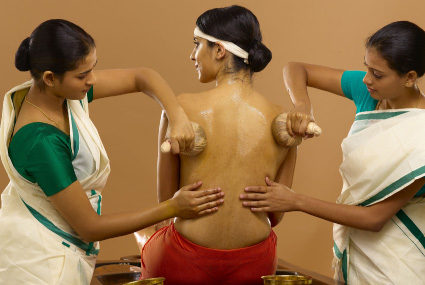
Treatment For Back Pain
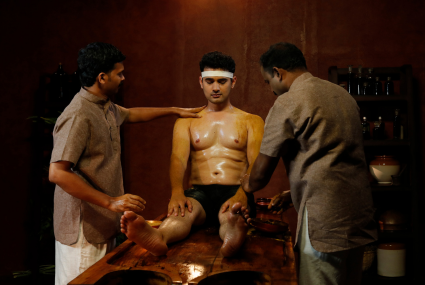
Central to Ayurveda is the concept of balance and harmony within the body, achieved through a combination of natural remedies, lifestyle adjustments, and therapeutic practices. Herbal remedies play a significant role in Ayurvedic treatment for back pain. Various herbs and botanicals with anti-inflammatory and analgesic properties are utilized to reduce swelling, alleviate muscle tension, and relieve pain. These may include substances such as ginger, turmeric, ashwagandha, and guggulu, which have been used for centuries to support musculoskeletal health and promote overall well-being. Dietary modifications are another essential aspect of Ayurvedic therapy for back pain. Recommendations typically involve consuming foods that possess anti-inflammatory properties while avoiding those that can contribute to inflammation and aggravate discomfort. Additionally, emphasis is placed on maintaining proper digestion and eliminating toxins from the body, as digestive health is closely linked to overall wellness in Ayurveda. Incorporating lifestyle adjustments is integral to the Ayurvedic approach to managing back pain. This may involve adopting correct posture habits, engaging in regular physical activity to strengthen the back muscles and improve flexibility, and implementing stress-reducing practices such as meditation and deep breathing exercises. By addressing the root cause of back pain through lifestyle modifications, Ayurveda aims to prevent future occurrences and promote long-term relief. Ayurvedic therapies offer a range of specialized treatments tailored to individuals experiencing back pain. These may include Panchakarma detoxification procedures to cleanse the body of accumulated toxins, as well as therapeutic massages using specific herbal oils to soothe sore muscles, improve circulation, and promote relaxation. Yoga and meditation are also commonly prescribed as part of Ayurvedic therapy, offering gentle yet effective methods to alleviate tension, restore balance, and enhance overall spinal health. In essence, Ayurvedic treatment for back pain provides a holistic and personalized approach that addresses the interconnectedness of the body, mind, and spirit. By restoring harmony within the individual, Ayurveda not only offers relief from back pain but also fosters a state of optimal health and well-being.
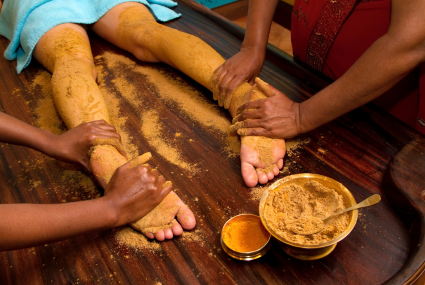
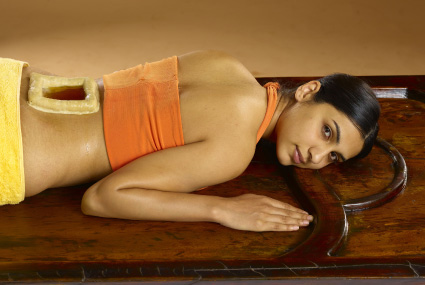
Spine Care Program
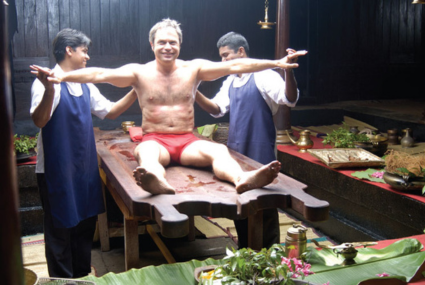
The Spine Care Program in Ayurveda is designed to address chronic back pain, cervical and lumbar spondylosis, sciatica, and disc degeneration by targeting the root cause of imbalance in the body. Treatments like Kati Basti, Pizhichil, Njavarakizhi, and Abhyanga help relieve pain, reduce stiffness, and improve spinal flexibility. These therapies are combined with herbal medications, internal detoxification, yoga postures, and a corrective diet to rejuvenate spinal nerves and strengthen musculoskeletal support. Ayurvedic spine care not only alleviates symptoms but also helps prevent recurrence, making it a safe and sustainable alternative to invasive treatments or long-term dependency on painkillers.
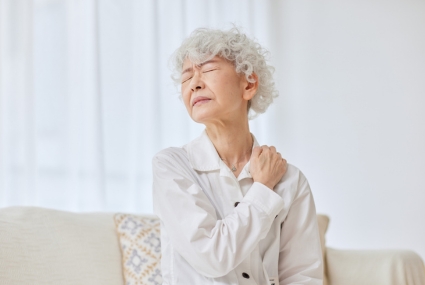
Pain Management
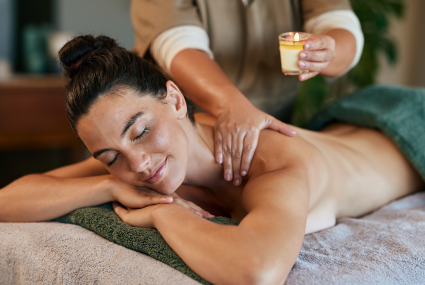
Pain Management Issues include a wide range of musculoskeletal, neurological, inflammatory, and degenerative conditions that may cause persistent or recurring pain, stiffness, restricted movement, and physical discomfort. These conditions can affect different parts of the body and may interfere with mobility, daily activities, physical performance, and overall quality of life. Ayurveda considers pain through the relationship between Vata, Pitta, and Kapha Doshas, with particular emphasis on Vata imbalance, which is traditionally associated with pain, restricted movement, and functional disturbances. The accumulation of Ama (incompletely processed substances) and imbalances affecting Dhatus (body tissues) and Srotas (body channels) are also considered in Ayurvedic assessment. A personalised evaluation examines the nature, location, intensity, duration, and underlying causes of pain, alongside the individual's Prakriti (natural constitution), Vikriti (current imbalance), physical strength, and health history. This approach helps determine appropriate therapeutic strategies to manage discomfort, support affected tissues, improve mobility, and maintain physical function. Ayurvedic Pain Management combines traditional therapeutic procedures, individualised herbal support, and restorative lifestyle practices to address different types of physical discomfort. Depending on clinical assessment, treatment may include Snehana (oleation therapy), Swedana (therapeutic fomentation), Abhyanga (medicated oil massage), Kizhi (herbal poultice therapy), Pizhichil (medicated oil therapy), Basti (medicated enema therapy), and other specialised Panchakarma procedures. These therapies are traditionally used to relieve muscular tension, reduce stiffness, encourage relaxation, and support joint and musculoskeletal function. Complementary practices such as therapeutic yoga, physiotherapy where appropriate, gentle mobility exercises, personalised nutrition, and daily lifestyle adjustments may help improve physical comfort and support functional rehabilitation. The integrated approach aims to improve pain control, maintain flexibility, enhance movement, and support long-term physical well-being, with therapeutic plans adapted to individual conditions, treatment tolerance, and recovery needs under qualified medical supervision, alongside conventional evaluation and treatment when required.
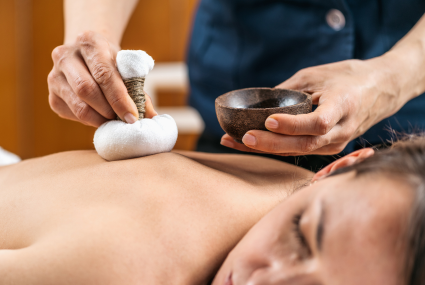
Mechanical Back Syndrome Treatment
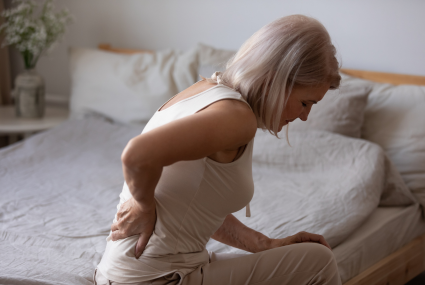
Mechanical Back Syndrome refers to back pain that arises from problems in the muscles, ligaments, joints, or discs of the spine rather than from a serious underlying disease. It is one of the most common causes of back pain and can affect people of all ages, especially those with sedentary lifestyles or occupations involving prolonged sitting or heavy physical work. Common symptoms include localized pain in the lower or middle back, muscle stiffness, difficulty bending or twisting, and discomfort that worsens with movement or prolonged sitting. The pain often improves with rest or gentle movement but may return if the underlying strain or posture problem is not corrected. Factors that may contribute to this condition include poor posture, muscle strain, improper lifting techniques, prolonged sitting, lack of physical activity, and stress on the spinal structures. In Ayurveda, back pain conditions such as this are often related to Vata imbalance, particularly affecting the lower back region. Aggravated Vata can lead to dryness, stiffness, and pain in the muscles and joints of the spine. Ayurvedic management focuses on calming Vata, relaxing the muscles, improving circulation, and strengthening the spine. Treatment may include warm and nourishing foods, herbal medicines that support musculoskeletal health, and lifestyle practices that improve posture and spinal alignment. Therapies such as Abhyanga (medicated oil massage) help relax muscles and nourish tissues, while Swedana (therapeutic sweating) helps reduce stiffness and improve circulation. Basti (medicated enema therapy) is considered one of the most effective therapies for balancing Vata and supporting spinal health. Additional treatments such as Kati Basti (localized oil therapy for the lower back), gentle yoga, stretching exercises, and posture correction may also help relieve pain and improve back strength and flexibility.
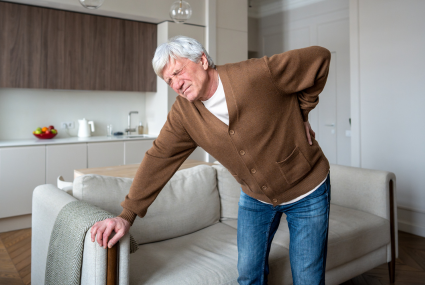
Ankylosing Spondylosis Treatment
Ankylosing Spondylosis is a long-term inflammatory condition that primarily affects the spine, especially the lower back and sacroiliac joints. It causes chronic pain and stiffness, particularly in the lower back and hips. The pain and stiffness are often more noticeable in the morning or after periods of rest and may improve with movement or exercise. As the condition progresses, inflammation may lead to gradual fusion of the vertebrae, reducing flexibility of the spine and sometimes causing a forward-bent posture. Some individuals may also experience pain in the shoulders, ribs, or hips, along with fatigue and reduced mobility. In Ayurveda, conditions affecting the spine and joints like Ankylosing Spondylosis are often understood as disorders related to Vata imbalance, sometimes associated with Ama (toxins) accumulating in the joints and spinal structures. This can lead to stiffness, restricted movement, inflammation, and pain. Ayurvedic management focuses on balancing Vata, reducing inflammation, improving joint flexibility, and strengthening the musculoskeletal system. Treatment may include anti-inflammatory and strengthening herbal medicines, a diet that supports digestion and reduces toxins, and lifestyle practices that maintain joint mobility. Therapies such as Abhyanga (medicated oil massage) help lubricate and relax the muscles and joints, while Swedana (therapeutic sweating) helps relieve stiffness and improve circulation. Basti (medicated enema therapy) is often recommended to balance Vata and support spinal health. Gentle yoga, stretching exercises, and posture correction practices can also help maintain flexibility and improve quality of life.
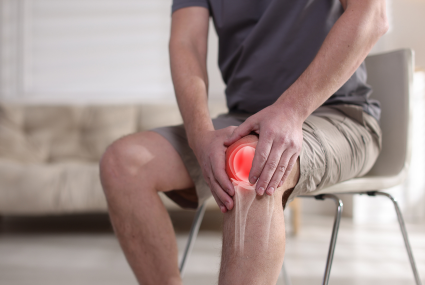
Treatment For Slip Disc
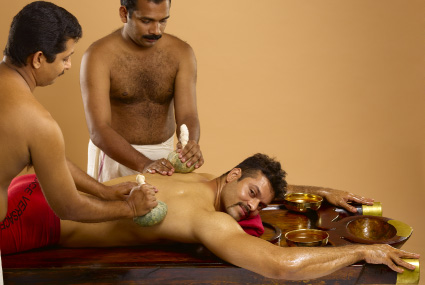
Central to Ayurvedic principles is the belief in restoring balance within the body to facilitate natural healing processes. Herbal medicines play a significant role, with formulations targeting pain relief, reducing inflammation, and strengthening the spine. These may include potent herbs like ashwagandha, guggulu, and shallaki, known for their anti-inflammatory and analgesic properties. Dietary modifications form another cornerstone, with emphasis on consuming foods that pacify aggravated doshas (energies) contributing to the slip disc condition. This often involves incorporating anti-inflammatory foods, warm and nourishing meals, and avoiding triggers such as processed foods and excess caffeine. Lifestyle adjustments are crucial, including maintaining proper posture, avoiding prolonged sitting or standing, and engaging in gentle exercises to promote spinal flexibility and strength. Ayurveda also advocates for stress management techniques like meditation and pranayama (breath control) to alleviate mental tension, which can exacerbate symptoms. Panchakarma, a series of detoxification procedures, may be recommended to rid the body of accumulated toxins and restore balance. Techniques such as basti (medicated enemas) and kati basti (localized oil therapy) are often employed to target the affected area directly, providing relief from pain and stiffness. External therapies like hot oil massages (abhyanga) with specific herbal oils tailored to the individual's constitution can help alleviate muscle tension and promote circulation to the affected area. Additionally, herbal poultices (kizhi) containing a blend of therapeutic herbs may be applied to the spine to reduce inflammation and promote tissue healing. Ayurvedic treatment for slip disc is not merely symptomatic but aims at addressing the underlying imbalances contributing to the condition. By fostering harmony within the body-mind system, Ayurveda seeks to not only alleviate immediate discomfort but also prevent recurrence and promote overall well-being. It's essential for individuals considering Ayurvedic treatment to consult with a qualified practitioner who can tailor a holistic regimen suited to their unique needs and constitution.
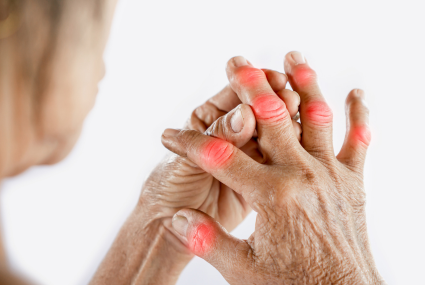
Treatment For Arthritis
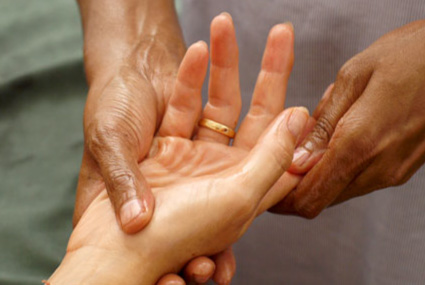
Herbal remedies play a central role in Ayurvedic treatments for arthritis and spondylitis. Medicinal herbs such as turmeric, ginger, boswellia, ashwagandha, and guggulu are renowned for their anti-inflammatory properties and ability to support joint health. These herbs can be consumed orally as powders, capsules, or teas, or applied topically in the form of oils or ointments. Dietary modifications are another cornerstone of Ayurvedic therapy. Emphasizing a diet that is warm, nourishing, and easily digestible, Ayurveda recommends avoiding foods that aggravate the doshas associated with arthritis and spondylitis, such as cold, dry, and processed foods. Including spices like cumin, coriander, and turmeric in cooking can also aid digestion and reduce inflammation. In addition to herbal remedies and dietary adjustments, Ayurvedic treatment often incorporates lifestyle modifications and therapeutic practices to promote overall well-being. Gentle exercises like yoga and tai chi can improve flexibility, strengthen muscles, and enhance joint mobility. Ayurvedic therapies such as Abhyanga (oil massage), Swedana (herbal steam therapy), and Basti (medicated enema) may also be recommended to detoxify the body, reduce pain, and restore balance. By addressing the interconnectedness of the mind, body, and spirit, Ayurvedic treatment for arthritis and spondylitis aims to not only alleviate physical discomfort but also to promote holistic healing and improve quality of life. However, it's important to consult with a qualified Ayurvedic practitioner to receive personalized guidance and ensure safe and effective treatment.
When Joints and Muscles Call for Care: An Ayurvedic Path to Pain Relief and Sustained Mobility
Musculoskeletal conditions and chronic pain represent some of the most prevalent global health concerns affecting hundreds of millions worldwide with substantial impact on mobility, work productivity, quality of life, and overall wellness. Low back pain alone affects an estimated 619 million people globally and represents the leading cause of disability worldwide. The convergence of sedentary modern lifestyles, postural concerns, repetitive strain patterns, accumulated wear-and-tear, autoimmune conditions, sports and exercise injuries, and aging-related changes has produced substantial musculoskeletal burden across populations.
Common musculoskeletal and pain conditions include:
- Osteoarthritis (Sandhivata) — Substantial global prevalence
- Rheumatoid arthritis (Amavata) (supportive) — Substantial classical use
- Ankylosing spondylitis (Asthi Majjagata Vata) (supportive)
- Psoriatic arthritis (supportive)
- Gout (Vatarakta)
- Chronic low back pain
- Sciatica (Gridhrasi) — Substantial classical use
- Chronic neck pain
- Cervical spondylosis
- Lumbar spondylosis
- Disc-related conditions (supportive)
- Frozen shoulder (Apabahuka) — Substantial classical use
- Periarthritic shoulder
- Tennis elbow and Golfer's elbow (Kaphaja Vatakantaka) — Substantial classical use
- Carpal tunnel syndrome
- Tendinitis — Multiple types
- Fibromyalgia (supportive)
- Chronic widespread pain
- Sports injuries — Recovery and rehabilitation
- Post-surgical orthopedic recovery
- Post-fracture recovery with appropriate timing
- Osteoporosis (supportive)
- Scoliosis (supportive) — Structural with realistic framing
- Kyphosis (supportive)
- Plantar fasciitis
- Heel pain
- Knee pain including chondromalacia patellae
- Hip pain
- Muscular dystrophy (supportive) — Progressive with substantial care
- Myositis (supportive)
- Chronic stress-related musculoskeletal pain
- Aging-related musculoskeletal changes
Modern medical management has substantially advanced with comprehensive evidence-based framework including specialized orthopedics, rheumatology, pain management, and physiotherapy evaluation, comprehensive osteoarthritis management (lifestyle, physiotherapy, NSAIDs, intra-articular injections, surgical interventions when indicated), comprehensive rheumatoid arthritis management including biologics and DMARDs with substantial recent advances, comprehensive ankylosing spondylitis management including biologics, comprehensive pain management including multidisciplinary approaches, comprehensive surgical orthopedics including joint replacement with substantial outcomes evidence, physiotherapy and rehabilitation with substantial evidence, and substantial recent therapeutic advances.
Classical Ayurveda addresses musculoskeletal conditions through comprehensive Vata Vyadhi framework recognizing that the vast majority of musculoskeletal and pain conditions involve substantial Vata dimensions with substantial classical literature in Charaka Samhita and broader texts providing sophisticated framework. The classical understanding centers on the principle that musculoskeletal conditions involve Vata aggravation affecting Asthi Dhatu (bone tissue), Sandhi (joints), Majja Dhatu (nervous tissue/marrow), Mamsa Dhatu (muscle tissue), Snayu (ligaments), and Kandara (tendons) — with comprehensive integrative approach addressing all dimensions.
The therapeutic framework provides comprehensive approach through comprehensive Vata-pacifying approach as foundational; comprehensive Basti as cornerstone Panchakarma for Vata Vyadhi with substantial classical use; specialized localized therapies including Kati Basti for back, Janu Basti for knees, Greeva Basti for neck, broader specific localized Basti therapies; Pizhichil for substantial conditions; Patra Pinda Sweda for warming applications; classical Vata-pacifying formulations matched to specific conditions; comprehensive Rasayana approach for sustained musculoskeletal wellness; gentle therapeutic Yoga integration; comprehensive lifestyle integration; and absolute coordination with continued orthopedic, rheumatology, and pain management care including continued essential medications which must never be discontinued without specialist guidance.
What is Musculoskeletal Health & Pain Management in Ayurveda?
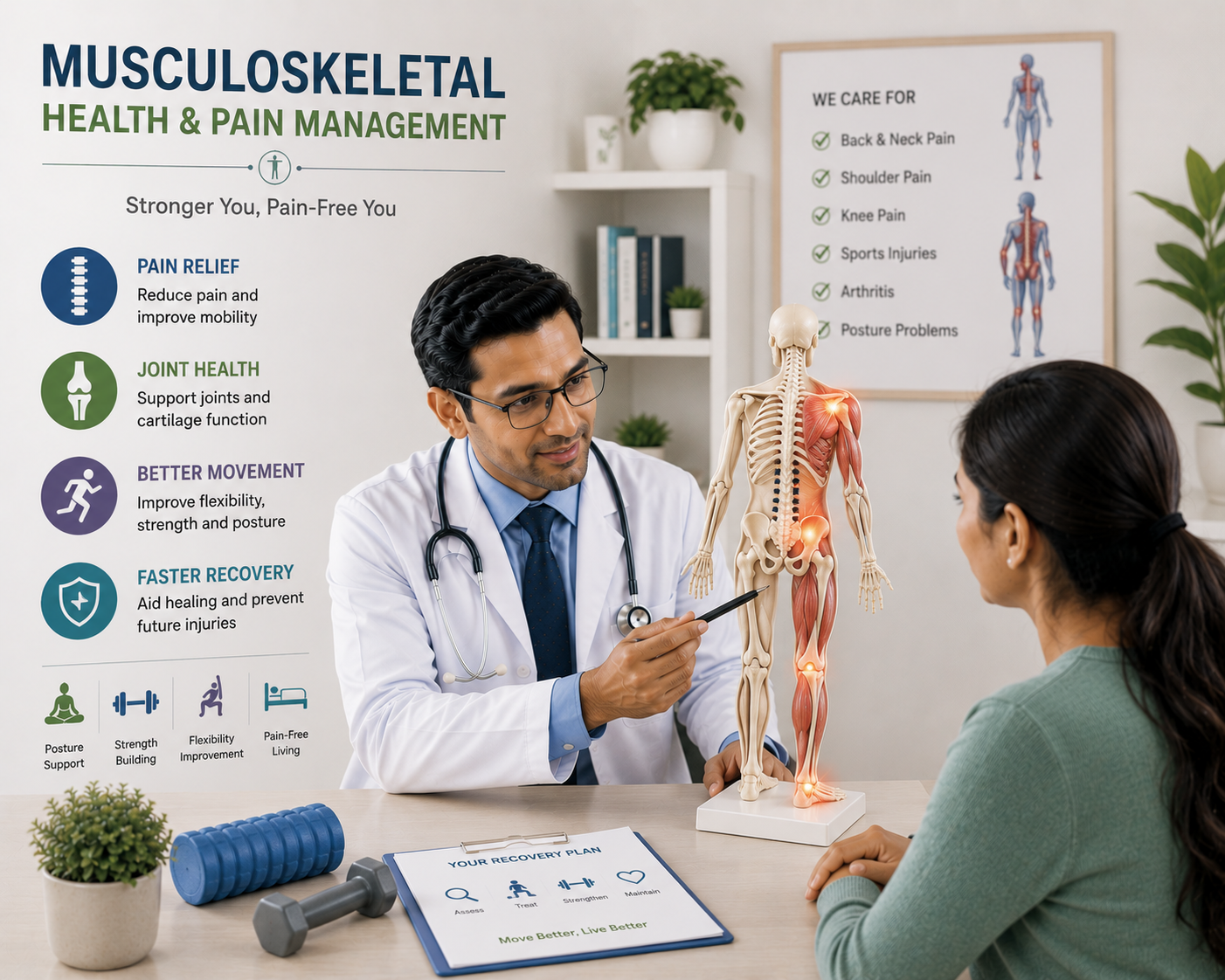
Musculoskeletal health and pain management in Ayurveda represents the comprehensive classical framework addressing joint, bone, muscle, ligament, tendon, and broader musculoskeletal conditions through the integrated Vata Vyadhi approach.
Definition and characteristics:
- Comprehensive musculoskeletal framework
- Centered on Vata Vyadhi, Asthi-Sandhi-Majja-Mamsa Dhatu, Amavata, Vatarakta
- Substantial classical literature foundation
- Both preventive and therapeutic applications
- Integration with continued conventional orthopedic, rheumatology, and pain management care
Scope encompasses:
Arthritis spectrum:
- Osteoarthritis (Sandhivata) — Substantial classical use
- Rheumatoid arthritis (Amavata) (supportive)
- Ankylosing spondylitis (Asthi Majjagata Vata) (supportive)
- Psoriatic arthritis (supportive)
- Gout (Vatarakta)
- Reactive arthritis (supportive)
- Juvenile arthritis (supportive)
Spine conditions:
- Chronic low back pain
- Sciatica (Gridhrasi)
- Chronic neck pain
- Cervical spondylosis
- Lumbar spondylosis
- Disc-related conditions (supportive)
- Spinal stenosis (supportive)
Specific joint conditions:
- Frozen shoulder (Apabahuka)
- Periarthritic shoulder
- Tennis elbow (Lateral epicondylitis)
- Golfer's elbow (Medial epicondylitis)
- Knee conditions including chondromalacia patellae
- Hip conditions
- Carpal tunnel syndrome
Soft tissue:
- Tendinitis — Multiple types
- Bursitis
- Plantar fasciitis
- Heel pain
- Muscle strains (subacute and chronic)
- Sprains (subacute and chronic)
Chronic pain syndromes:
- Fibromyalgia (supportive)
- Chronic widespread pain
- Chronic pain with mental dimensions
Sports and rehabilitation:
- Sports injuries — Recovery and rehabilitation
- Post-surgical orthopedic recovery
- Post-fracture recovery
Bone conditions:
- Osteoporosis (supportive)
- Osteopenia
Structural (supportive with realistic framing):
- Scoliosis (supportive)
- Kyphosis (supportive)
Progressive conditions (supportive):
- Muscular dystrophy (supportive)
- Myositis (supportive)
Broader:
- Chronic stress-related musculoskeletal pain
- Aging-related musculoskeletal changes
- Posture-related conditions
Core therapeutic frameworks:
- Comprehensive Vata-pacifying approach
- Basti as cornerstone Panchakarma
- Specialized localized therapies (Kati Basti, Janu Basti, Greeva Basti, broader)
- Pizhichil for substantial conditions
- Patra Pinda Sweda
- Classical Vata-pacifying formulations
- Comprehensive Rasayana
- Gentle therapeutic Yoga integration
- Comprehensive lifestyle integration
- Coordination with continued orthopedic and rheumatology care
Understanding Vata Vyadhi, Asthi-Sandhi-Majja, and Amavata: The Ayurvedic Framework
The Ayurvedic understanding of musculoskeletal health sits within comprehensive classical framework with substantial literature.
Key concepts:
Vata Vyadhi as Central Framework:
Vata Vyadhi considered fundamental classical framework for musculoskeletal conditions with substantial classical recognition:
- Vata aggravation central to most musculoskeletal pain conditions
- Substantial classical literature including dedicated Vata Vyadhi chapters
- Comprehensive framework for multiple specific conditions
Asthi-Sandhi-Majja-Mamsa Dhatu Framework:
Specific tissue involvement framework:
- Asthi Dhatu (bone tissue) — Bone-related conditions
- Sandhi (joints) — Joint conditions
- Majja Dhatu (nervous tissue/marrow) — Nerve-related conditions
- Mamsa Dhatu (muscle tissue) — Muscle conditions
- Snayu (ligaments) — Ligament conditions
- Kandara (tendons) — Tendon conditions
Specific Classical Conditions:
Sandhivata (Osteoarthritis):
Detailed classical framework with sophisticated understanding:
- Vata aggravation in joints
- Substantial classical literature
- Comprehensive treatment approach
Amavata (Rheumatoid Arthritis-like):
Detailed classical framework with substantial sophistication:
- Ama (toxins) + Vata combination
- Specific systemic inflammatory framework
- Comprehensive classical treatment
- Sophisticated classical observation anticipating modern autoimmune understanding
Asthi Majjagata Vata (Ankylosing Spondylitis-like):
Classical framework for deep-seated Vata Vyadhi.
Vatarakta (Gout):
Classical framework with sophisticated understanding:
- Vata + Rakta vitiation
- Specific dietary causation recognized
- Comprehensive treatment approach
Gridhrasi (Sciatica):
Detailed classical framework with substantial sophistication:
- Two types based on doshic patterns
- Comprehensive treatment approach
- Substantial classical literature
Apabahuka (Frozen Shoulder):
Classical framework with substantial classical use.
Other Specific Conditions:
- Numerous Vata Vyadhi subtypes with classical descriptions
- Comprehensive framework
Specific Doshic Patterns:
Vata-predominant (most musculoskeletal):
- Pain, stiffness, restricted movement
- Crepitus and degenerative patterns
- Cold-aggravated conditions
- Chronic recurrent patterns
Vata-Kapha combinations:
- Specific patterns with stiffness and swelling
- Cold conditions with congestive dimensions
- Amavata patterns
Vata-Pitta combinations:
- Inflammatory musculoskeletal conditions
- Warm painful joints
- Specific patterns
Tridoshic:
- Complex chronic conditions
- Long-standing combined patterns
Ama Concept:
Substantial classical recognition of Ama-Vata combinations particularly in Amavata — recognition anticipating modern autoimmune understanding.
Snigdha vs Ruksha Vata:
Classical distinction between dry-stiff Vata (typical degenerative) and wet-swollen Vata (Ama-Vata patterns) with specific treatment implications.
Predisposing Factors Classical Ayurveda Identifies:
Aharaja (Dietary):
- Excessive Vata-aggravating foods (cold, dry, light)
- Inadequate nourishing diet
- Viruddha Ahara (incompatible foods) in autoimmune patterns
- Specific Ama-promoting foods
Viharaja (Lifestyle):
- Sedentary lifestyle with substantial classical recognition
- Excessive physical exertion
- Poor posture (substantial modern recognition)
- Inadequate sleep
- Cold exposure
- Suppression of natural urges
- Repetitive strain patterns
Manasika (Mental):
- Chronic stress with substantial musculoskeletal impact
- Anxiety with substantial muscular tension
- Emotional suppression
Specific Conditions:
- Genetic predisposition
- Autoimmune predisposition
- Trauma history
- Aging
Aging:
- Substantially increasing Vata with aging with substantial classical recognition
- Natural degenerative changes
This shapes the Ayurvedic approach to musculoskeletal health: comprehensive Vata-pacifying approach as foundational; comprehensive Basti as cornerstone Panchakarma; specialized localized Basti therapies matched to specific affected regions; Pizhichil for substantial conditions; Patra Pinda Sweda for warming applications; dosha-specific approach; specific Ama clearing for Amavata and broader Ama-related patterns; classical formulations; comprehensive Rasayana; gentle therapeutic Yoga integration; comprehensive lifestyle integration; substantial stress management; coordination with continued orthopedic, rheumatology, and pain management care.
The 3 Stages of Ayurvedic Treatment for Musculoskeletal Health & Pain Management
1. Preparation (Purva Karma) — Typically 3-7 days
Comprehensive assessment including detailed musculoskeletal history (specific conditions, duration, current symptoms, pain patterns, functional limitations, prior treatments and response, current medications), current orthopedic/rheumatology evaluation including recent imaging when applicable, current physiotherapy involvement, comorbidities, dietary patterns, lifestyle factors with substantial attention to posture, ergonomics, exercise, sleep, family history particularly autoimmune dimensions, occupational factors, and constitutional profile.
Orthopedic and rheumatology coordination essential when applicable.
Critical screening:
- Stable current condition
- No acute fracture requiring orthopedic management
- No suspected septic arthritis requiring urgent care
- No suspected malignancy with musculoskeletal involvement
- No acute neurological symptoms (significant weakness, bladder/bowel involvement) requiring urgent evaluation
- No active severe autoimmune flare requiring specialist management
- Stable cardiovascular status for therapeutic interventions
Initial gentle constitutional support. Initial Vata-pacifying dietary modifications. Foundational lifestyle measures including posture awareness, ergonomic optimization, stress management foundation.
2. Core Treatment (Pradhana Karma) — Typically 14-21 days
Comprehensive Basti as Cornerstone:
Basti therapy as fundamental Vata Vyadhi intervention:
- Niruha Basti with appropriate decoctions
- Anuvasana Basti with appropriate medicated oils
- Matra Basti for sustained gentle therapy
- Yapana Basti for chronic conditions
- Kala Basti schedule for substantial conditions
- Karma Basti with comprehensive sequence
Specialized Localized Basti Therapies:
Kati Basti — Substantial classical lower back therapy:
- Medicated oil retention over lumbar spine
- Circular dam over lumbar region
- Standard preparations: Mahanarayana Taila, Sahacharadi Taila, specific oils
- Substantial benefits for chronic low back pain, lumbar spondylosis, sciatica, broader lower back conditions
- Daily for 7-14 days
Janu Basti — Specialized knee therapy:
- Medicated oil retention over knee
- Substantial benefits for osteoarthritis, knee pain, broader knee conditions
Greeva Basti — Specialized neck therapy:
- Medicated oil retention over cervical spine
- Substantial benefits for chronic neck pain, cervical spondylosis
Manya Basti — For neck/throat region
Bhru Madhya Basti — For head/forehead applications
Bahu Basti — For shoulder applications
Specialized External Therapies:
Pizhichil — Substantial classical therapy:
- Continuous warm medicated oil bathing
- Substantial classical use for Vata Vyadhi
- Comprehensive nourishing and tissue-strengthening effects
- Particularly valuable for substantial conditions
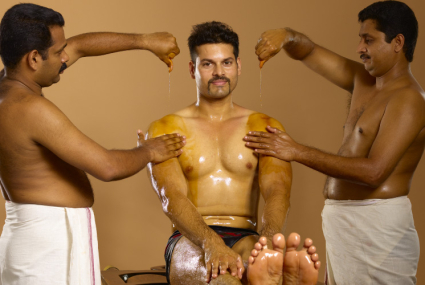
Abhyanga — Daily oil massage:
- Mahanarayana Taila as cornerstone classical Vata-pacifying oil
- Sahacharadi Taila for substantial classical use
- Ksheerabala Taila for substantial nervous system applications
- Bala Taila for foundational support
- Dhanwantharam Taila for broader Vata applications
- Specific oils matched to needs
Patra Pinda Sweda — Substantial classical warming therapy:
- Warmed medicinal leaf bundle massage
- Substantial classical use for Vata Vyadhi
- Particularly valuable for chronic conditions
- Comprehensive warming and circulation effects
Shashtika Shali Pinda Sweda — Substantial classical nourishing therapy:
- Warmed rice bolus massage
- Substantial classical use for substantial musculoskeletal applications
- Comprehensive tissue-nourishing effects
- Particularly valuable for degenerative and weakness patterns
Specific Local Applications:
- Lepa (medicated paste applications) for specific conditions
- Bandhana (medicated wrapping) for specific applications
- Specific therapeutic applications matched to conditions
Comprehensive Vata-Pacifying Shamana Therapy:
Foundational Vata-pacifying herbs and formulations:
- Dashamoola — comprehensive Vata pacification
- Rasna (Pluchea lanceolata) classical Vata Vyadhi herb
- Ashwagandha for adaptogenic and Mamsa support
- Bala (Sida cordifolia) classical Vata Vyadhi herb
- Specific Vata-pacifying preparations matched to condition
Classical formulations matched to conditions:
For osteoarthritis (Sandhivata):
- Yogaraj Guggulu as foundational
- Maharasnadi Kashayam
- Dhanwantharam Kashayam
- Specific OA preparations
For rheumatoid arthritis (Amavata):
- Simhanada Guggulu with substantial classical use
- Rasna Saptaka Kashayam
- Amavatari Rasa for substantial classical use
- Ama-clearing approach essential first
- Specific RA-supportive formulations
For ankylosing spondylitis (supportive):
- Comprehensive Vata-Kapha approach
- Specific formulations matched to patterns
- Substantial classical Asthi Majjagata Vata approach
For gout (Vatarakta):
- Kaishore Guggulu with substantial classical use
- Manjishtha
- Guduchi
- Specific Vatarakta formulations
For sciatica (Gridhrasi):
- Yogaraj Guggulu
- Dashamoolarishtam
- Maharasnadi Kashayam
- Sahacharadi Taila for external use
- Specific Gridhrasi formulations
For frozen shoulder (Apabahuka):
- Substantial classical formulations
- Specific external therapies
- Substantial classical Apabahuka approach
For tendinitis including tennis/golfer's elbow:
- Specific Vata-pacifying formulations
- Specialized external applications
- Specific tendinitis approach
For fibromyalgia (supportive):
- Comprehensive Vata-pacifying approach
- Stress management central
- Comprehensive supportive approach
For osteoporosis (supportive):
- Lakshadi Guggulu with substantial classical use
- Asthi Poshak Rasayana
- Comprehensive bone-supportive approach
- Continued conventional therapy when prescribed
For sports injuries and post-surgical recovery:
- Comprehensive tissue-supportive approach
- Specific Rasayana
- Comprehensive rehabilitation integration
Comprehensive Rasayana Approach:
- Chyavanaprasha for comprehensive Rasayana
- Specific musculoskeletal Rasayana
- Asthi Poshak Rasayana for bone support
Gentle Therapeutic Yoga Integration:
- Specific asanas matched to condition
- Therapeutic Yoga
- Restorative Yoga
- Gentle stretching appropriate
- Pranayama
- Avoiding aggravating practices
Comprehensive Dietary Integration:
- Vata-pacifying warm foods
- Adequate quality protein
- Healthy fats including ghee
- Specific musculoskeletal-supportive foods
- Adequate calcium and vitamin D
- Adequate hydration
For Amavata:
- Ama-clearing dietary approach essential
- Avoiding Ama-promoting foods
- Specific Amavata dietary integration
Foods to avoid:
- Cold, dry, hard foods aggravating Vata
- Excessive processed foods
- Specific food triggers
Comprehensive Lifestyle Integration:
- Posture optimization
- Ergonomic improvements
- Regular gentle exercise
- Adequate sleep
- Comprehensive stress management
- Avoiding cold exposure for sensitive patterns
Coordination with Continued Care:
- Continued essential medications
- Continued physiotherapy integration
- Continued specialist follow-up
3. Rejuvenation (Paschat Karma) — Continued home regimen
Sustained Vata-pacifying approach, continued constitutional approach, continued home Abhyanga, continued lifestyle integration, continued Yoga and exercise, periodic clinical follow-up. Long-term framework — musculoskeletal wellness requires sustained integrated approach.
The 5 Core Therapies for Musculoskeletal Health & Pain Management Explained
1. Basti as Cornerstone Panchakarma for Vata Vyadhi Basti (medicated enema) represents the most clinically valuable Panchakarma for musculoskeletal conditions with substantial classical use as cornerstone Vata Vyadhi intervention — considered the most universally applicable Panchakarma procedure. Substantial classical recognition that since Vata predominantly resides in the colon (Pakvashaya), direct colonic intervention through Basti provides comprehensive systemic Vata pacification with substantial musculoskeletal benefits. Comprehensive Basti approach: Niruha Basti (cleansing decoction enema) with appropriate medicated decoctions matched to specific conditions; Anuvasana Basti (nourishing oil enema) with appropriate medicated oils; Matra Basti for sustained gentle therapy with substantial classical use as can be administered without strict preparatory protocols; Yapana Basti as nourishing Basti providing comprehensive constitutional support for chronic conditions; Kala Basti following 16-day classical schedule; Karma Basti with comprehensive 30-day sequence for substantial conditions. Standard medicated preparations: classical Vata-pacifying decoctions including Erandamooladi Niruha Basti for specific musculoskeletal applications; Mahanarayana Taila Anuvasana with substantial classical use; Sahacharadi Taila Anuvasana; Ksheerabala Taila Anuvasana; specific preparations matched to individual patterns. Mechanisms: direct Apana Vata pacification through colon with substantial systemic Vata Vyadhi benefits; comprehensive constitutional support; specific musculoskeletal benefits through Vata regulation; broader integrative effects. Specific musculoskeletal applications: substantial classical use for osteoarthritis (Sandhivata), rheumatoid arthritis (Amavata) with appropriate sequencing after Ama clearing, ankylosing spondylitis supportive, chronic low back pain, sciatica (Gridhrasi) with substantial classical use, chronic neck pain, frozen shoulder (Apabahuka), tendinitis including tennis/golfer's elbow, chronic widespread pain, fibromyalgia supportive, post-surgical orthopedic recovery, broader Vata Vyadhi applications. Critical requirements: comprehensive Purva Karma preparation; substantial practitioner expertise; appropriate sterile clinical infrastructure; appropriate patient selection; comprehensive Paschat Karma. Continues alongside continued orthopedic, rheumatology, and pain management care. WellnessLoka Kerala centres provide expert Basti capability.
2. Specialized Localized Basti Therapies — Kati Basti, Janu Basti, Greeva Basti Specialized localized Basti therapies provide substantial value for specific musculoskeletal applications with substantial classical use providing direct localized therapeutic effects to affected regions. Kati Basti — Substantial classical lower back specialized therapy: medicated oil retention over the lumbar spine through circular dam created with dough placed over the lumbar region filled with warm medicated oil providing direct localized therapeutic effects to the lumbar spine; standard preparations: Mahanarayana Taila as cornerstone Vata-pacifying oil with substantial classical use, Sahacharadi Taila for substantial Vata Vyadhi applications, Ksheerabala Taila for nervous system applications, specific oils matched to needs; substantial documented benefits: substantial pain relief, improved circulation, muscle relaxation, comprehensive Vata pacification in lumbar region; particularly valuable for: chronic low back pain as cornerstone therapy with substantial classical and emerging modern use, lumbar spondylosis, sciatica (Gridhrasi) with substantial classical use, disc-related conditions supportive, broader lower back conditions. Janu Basti — Specialized knee therapy: medicated oil retention over the knee through similar circular dam approach providing direct localized therapeutic effects; substantial benefits for osteoarthritis of knees with substantial classical and emerging modern use, knee pain broadly, chondromalacia patellae, post-knee surgery recovery, broader knee conditions. Greeva Basti — Specialized neck therapy: medicated oil retention over cervical spine providing direct localized therapeutic effects; substantial benefits for chronic neck pain, cervical spondylosis as cornerstone therapy with substantial classical and emerging modern use, specific cervical conditions. Bahu Basti — For shoulder applications with substantial benefits for frozen shoulder (Apabahuka), broader shoulder conditions. Bhru Madhya Basti — For head/forehead applications with specific applications. Manya Basti — For specific neck/throat applications. Standard course: typically 7-14 daily sessions with substantial cumulative benefits. Combined with comprehensive Basti, broader Panchakarma, and internal Vata-pacifying therapy for substantial integrative benefits. WellnessLoka Kerala centres provide expert specialized localized Basti therapies.
3. Pizhichil, Patra Pinda Sweda, and Specialized External Vata-Pacifying Therapies Pizhichil, Patra Pinda Sweda, and broader specialized external Vata-pacifying therapies provide substantial value for musculoskeletal conditions with substantial classical use. Pizhichil — Substantial Classical Therapy: continuous warm medicated oil bathing with substantial classical use — patient receives continuous gentle stream of warm medicated oil over entire body for 60-90 minutes; standard preparations: Mahanarayana Taila, Ksheerabala Taila, Dhanwantharam Taila, Sahacharadi Taila, specific oils matched to needs; mechanisms: comprehensive Vata pacification; substantial tissue nourishment; profound circulation enhancement; substantial muscle relaxation; comprehensive Mamsa Dhatu support; broader integrative effects with substantial classical Rasayana dimensions. Particularly valuable for: substantial Vata Vyadhi, chronic widespread pain, fibromyalgia supportive, muscular dystrophy supportive, post-stroke recovery, broader substantial musculoskeletal applications, broader degenerative conditions requiring substantial tissue support. Comprehensive Abhyanga: daily oil massage with substantial classical use as foundational musculoskeletal therapy; standard oils: Mahanarayana Taila as cornerstone classical Vata-pacifying oil with substantial classical use specifically for Vata Vyadhi, Sahacharadi Taila for substantial musculoskeletal applications, Ksheerabala Taila for nervous system applications, Bala Taila for foundational support, Dhanwantharam Taila for broader Vata applications, specific oils matched to needs; mechanisms: comprehensive Vata pacification, improved circulation, tissue nourishment, muscle relaxation, broader benefits. Patra Pinda Sweda — Substantial Classical Warming Therapy: warmed medicinal leaf bundle massage with bundles containing specific anti-inflammatory and Vata-pacifying leaves; substantial classical use specifically for Vata Vyadhi providing comprehensive warming, circulation, anti-inflammatory effects; particularly valuable for: chronic joint pain, muscular pain, chronic Vata Vyadhi, broader applications. Shashtika Shali Pinda Sweda — Substantial Classical Nourishing Therapy: warmed rice bolus massage with specially prepared medicated rice (Shashtika Shali) milk; substantial classical use for substantial nourishing applications; particularly valuable for: degenerative conditions, muscular weakness, post-illness recovery, substantial Mamsa Dhatu rebuilding, broader applications requiring substantial nourishment. Specific Local Applications: Lepa (medicated paste applications) for specific conditions including inflammation, swelling; Bandhana (medicated wrapping) for specific applications; specific therapeutic applications matched to conditions. Combined with comprehensive Basti, internal Vata-pacifying therapy, and continued conventional care.
4. Comprehensive Condition-Specific Classical Vata-Pacifying Formulations Comprehensive condition-specific classical Vata-pacifying formulations provide substantial value across the musculoskeletal spectrum with substantial classical use. Foundational Vata-pacifying herbs: Dashamoola (ten roots) for comprehensive Vata pacification; Rasna (Pluchea lanceolata) classical Vata Vyadhi herb with substantial classical use; Ashwagandha for adaptogenic and Mamsa support; Bala (Sida cordifolia) classical Vata Vyadhi herb; Guggulu preparations for anti-inflammatory and broader effects; specific Vata-pacifying preparations matched to conditions. For osteoarthritis (Sandhivata): Yogaraj Guggulu as foundational classical formulation with substantial use; Maharasnadi Kashayam with substantial classical use; Dhanwantharam Kashayam; specific OA-supportive preparations. For rheumatoid arthritis (Amavata): Simhanada Guggulu with substantial classical use specifically for Amavata; Rasna Saptaka Kashayam; Amavatari Rasa with substantial classical use; Vatari Guggulu for specific applications; comprehensive Ama-clearing approach essential first before nourishing therapies; specific RA-supportive preparations. For ankylosing spondylitis (supportive): comprehensive Vata-Kapha approach; specific Asthi Majjagata Vata formulations; continued biologics absolutely essential when prescribed. For gout (Vatarakta): Kaishore Guggulu with substantial classical use specifically for Vatarakta; Manjishtha for Rakta cleansing; Guduchi for broader support; specific Vatarakta formulations; dietary integration essential. For sciatica (Gridhrasi): Yogaraj Guggulu; Dashamoolarishtam; Maharasnadi Kashayam; Sahacharadi Taila for external use; Kati Basti integration; specific Gridhrasi formulations. For frozen shoulder (Apabahuka): substantial classical formulations including Yogaraj Guggulu, Dashamoolarishtam; specific external therapies; substantial classical Apabahuka approach with comprehensive integration. For tendinitis including tennis/golfer's elbow (Kaphaja Vatakantaka): specific Vata-pacifying formulations; specialized external applications; specific tendinitis approach. For fibromyalgia (supportive): comprehensive Vata-pacifying approach; stress management central; Ashwagandha as cornerstone adaptogen; specific supportive preparations. For osteoporosis (supportive): Lakshadi Guggulu with substantial classical use for bone support; Asthi Poshak Rasayana; comprehensive bone-supportive approach including dietary integration with calcium-rich foods, vitamin D considerations, weight-bearing exercise; continued conventional therapy when prescribed. For sports injuries and post-surgical recovery: comprehensive tissue-supportive approach; specific Rasayana including Asthi Poshak; comprehensive rehabilitation integration. Comprehensive individualized selection essential. Critical coordination with continued specialist medications — herbs complement rather than replace prescribed treatments; comprehensive medication interaction awareness essential particularly given biologic and DMARD interactions. WellnessLoka centres provide authentic preparations.
5. Gentle Therapeutic Yoga, Lifestyle Integration, and Coordination with Continued Care Gentle therapeutic Yoga integration, comprehensive lifestyle integration, and absolute coordination with continued orthopedic, rheumatology, and pain management care provide foundation for sustained musculoskeletal wellness. Gentle therapeutic Yoga integration: substantial classical and modern recognition of Yoga's musculoskeletal benefits; specific asanas matched to condition with appropriate selection; therapeutic Yoga approach with substantial evidence for chronic pain, arthritis, back pain, broader musculoskeletal conditions; restorative Yoga for chronic conditions; gentle stretching appropriate to capacity; Pranayama for relaxation and broader benefits; avoiding aggravating practices matched to specific condition; qualified therapeutic Yoga instruction essential — not generic Yoga but condition-aware therapeutic application. Comprehensive musculoskeletal-supportive dietary integration: Vata-pacifying warm foods as foundation; adequate quality protein essential for tissue support; healthy fats including ghee with substantial classical Vata-pacifying use; specific musculoskeletal-supportive foods including bone broths with substantial classical use, sesame seeds (rich in calcium and broader minerals), almonds, walnuts, dates; adequate calcium through dietary sources and supplementation when indicated; adequate vitamin D; specific spices including turmeric with substantial anti-inflammatory evidence, ginger with documented anti-inflammatory effects, fenugreek; adequate appropriate hydration. For Amavata (RA): Ama-clearing dietary approach essential including warm freshly prepared foods, easily digestible, specific Ama-clearing herbs and foods, avoiding Ama-promoting cold/heavy/incompatible foods. For Vatarakta (gout): specific dietary integration including avoiding purine-rich foods (substantial classical and modern recognition), avoiding alcohol particularly beer, adequate hydration. Foods to avoid: cold, dry, hard foods aggravating Vata; excessive processed foods; specific food triggers for autoimmune conditions; excessive alcohol; specific personal triggers. Comprehensive lifestyle integration: posture optimization with substantial musculoskeletal impact; ergonomic improvements essential for desk-based work and broader applications; regular gentle exercise appropriate to condition with substantial musculoskeletal evidence — walking, swimming particularly valuable; avoiding aggravating activities; adequate sleep essential with substantial musculoskeletal impact; comprehensive stress management central given substantial pain-stress interconnection; avoiding cold exposure for sensitive Vata patterns; comprehensive weight management when applicable with substantial musculoskeletal impact particularly for weight-bearing joints. Comprehensive coordination with continued orthopedic, rheumatology, and pain management care: continued essential medications absolutely essential including continued biologics and DMARDs (methotrexate, hydroxychloroquine, biologics) for rheumatoid arthritis and broader autoimmune conditions which provide substantial outcomes evidence and must never be discontinued without specialist guidance given substantial joint damage progression risk, continued NSAIDs when prescribed (with appropriate consideration of long-term use), continued specific medications for gout (allopurinol, colchicine), continued osteoporosis medications when prescribed, continued specific pain management medications; comprehensive medication interaction awareness essential for any herbal additions. Continued physiotherapy integration absolutely essential with substantial evidence base — Ayurvedic care complements physiotherapy; combined approach often produces superior outcomes. Continued specialist follow-up at appropriate intervals. Continued surgical interventions when indicated — joint replacement and broader procedures with substantial outcomes evidence. Critical safety: immediate medical care for acute concerns including suspected fracture, suspected septic arthritis, acute neurological symptoms (significant weakness, bladder/bowel involvement), suspected malignancy with musculoskeletal involvement; never delaying urgent care for retreat-based intervention. Honest framing: integrative care provides meaningful supportive value; does not replace continued essential treatment including continued essential medications and surgical interventions when indicated; realistic expectations. Centres claiming Ayurvedic cures for substantial musculoskeletal conditions or that biologics/joint replacement are unnecessary should be avoided as dangerous. WellnessLoka programs require continued essential care throughout.
How Long Should an Ayurvedic Treatment Program for Musculoskeletal Health Last?
| Duration | Therapeutic Benefit |
| 7–14 days | Initial protocols, established localized Basti course, foundational interventions |
| 14–21 days | Comprehensive constitutional support, established Pizhichil/Patra Pinda Sweda |
| 21–28 days | Extended program with comprehensive Basti and Panchakarma when indicated |
| Continued home regimen | Sustained Vata-pacifying approach and lifestyle integration essential |
The exact duration is decided after consultation with the Ayurvedic doctor in coordination with continued orthopedic, rheumatology, and pain management care, based on specific conditions, severity, current treatment, and individual factors. Substantial benefits typically develop over 2-6 months of sustained integrated approach. Critical recognition that musculoskeletal wellness requires sustained framework — Ayurvedic integration valuable as long-term approach with substantial ongoing value.
Book Consultation
Benefits of an Ayurvedic Treatment Retreat for Musculoskeletal Health
| Physical Benefits | Functional Benefits | Long-Term Impact |
| Pain reduction support | Better mobility and function | Sustained musculoskeletal wellness |
| Better joint flexibility support | Better daily functional capacity | Foundation for mobility preservation |
| Better tissue strength support | Better sleep quality | Better long-term outcomes |
| Better overall vitality | Better quality of life | Comprehensive integrative care framework |
Why Kerala is the Best Place for Musculoskeletal Health & Pain Management Treatment
An Ayurvedic musculoskeletal health and pain management retreat in Kerala, India offers the most clinically authentic environment for comprehensive Vata Vyadhi Ayurveda alongside continued essential orthopedic, rheumatology, and pain management care.
- Experienced physicians with specific expertise in classical Vata Vyadhi Ayurveda
- BAMS and MD Ayurveda-certified doctors with specialised training across the broad musculoskeletal spectrum
- Specialised practitioner training in comprehensive Basti as cornerstone Panchakarma for Vata Vyadhi
- Specialised practitioner training in specialized localized Basti therapies — Kati Basti for back, Janu Basti for knees, Greeva Basti for neck, broader specific localized Basti
- Specialised practitioner training in Pizhichil as substantial classical therapy
- Specialised practitioner training in Patra Pinda Sweda and Shashtika Shali Pinda Sweda as classical specialized therapies
- Specialised practitioner training in condition-specific classical Vata Vyadhi Ayurveda
- Authentic in-house preparation of cornerstone Vata-pacifying formulations — Yogaraj Guggulu, Simhanada Guggulu, Kaishore Guggulu, Lakshadi Guggulu, Maharasnadi Kashayam, Rasna Saptaka Kashayam, Dashamoolarishtam, Amavatari Rasa using authentic methods and fresh herbs
- Authentic preparation of cornerstone Vata-pacifying medicated oils — Mahanarayana Taila as foundational, Sahacharadi Taila with substantial classical use, Ksheerabala Taila for nervous system applications, Bala Taila for foundational support, Dhanwantharam Taila for broader Vata applications
- Authentic preparation of foundational Vata-pacifying herbs — Dashamoola, Rasna, Ashwagandha, Bala preparations
- Authentic preparation of Rasayana formulations — Chyavanaprasha, Asthi Poshak Rasayana for bone support
- Authentic preparation of Patra Pinda Sweda leaf preparations with appropriate medicinal leaves
- Authentic preparation of Shashtika Shali rice preparations with appropriate classical methodology
- Proper Panchakarma facilities for comprehensive Basti
- Proper specialized localized Basti facilities — Kati Basti, Janu Basti, Greeva Basti, broader specific facilities
- Proper Pizhichil facilities with appropriate clinical infrastructure
- Proper Patra Pinda Sweda and Shashtika Shali Pinda Sweda facilities
- Capacity for qualified therapeutic Yoga instruction with experienced teachers specifically trained in musculoskeletal applications
- Capacity for physiotherapy integration with substantial value
- Capacity for comprehensive monitoring including imaging coordination when needed
- Capacity for emergency medical escalation with clear protocols
- Long-established Kerala tradition of comprehensive musculoskeletal Ayurveda
- Coordination capability with continued orthopedic, rheumatology, and pain management care including continued essential medications
- Capacity for sustained long-term care relationships through chronic musculoskeletal condition management
- Capacity for comprehensive lifestyle integration including musculoskeletal-supportive dietary preparation, exercise programs, ergonomic optimization, stress management
- Capacity for sports injury and post-surgical recovery support with substantial rehabilitation integration
- Discretion and sensitivity throughout treatment
Sri Lanka offers complementary tropical healing environment, while Bali provides wellness-oriented treatment retreats integrating Ayurvedic care with holistic wellness. For specialised Vata Vyadhi Ayurveda with comprehensive Basti, specialized localized Basti therapies, Pizhichil, Patra Pinda Sweda, and authentic classical formulation preparation, Kerala offers the deepest tradition.
Musculoskeletal Health & Pain Management Treatment Retreats by Location and Recommended Centres
Kerala, India — The most clinically authentic destination for classical Vata Vyadhi Ayurveda with established tradition including specialised Basti capability as cornerstone Panchakarma, specialised localized Basti capability (Kati Basti, Janu Basti, Greeva Basti, broader), specialised Pizhichil capability, specialised Patra Pinda Sweda and Shashtika Shali Pinda Sweda capability, specialised condition-specific classical Vata Vyadhi Ayurveda, authentic in-house preparation of cornerstone Vata-pacifying formulations (Yogaraj Guggulu, Simhanada Guggulu, Kaishore Guggulu, Maharasnadi Kashayam, broader), authentic preparation of cornerstone Vata-pacifying medicated oils (Mahanarayana Taila, Sahacharadi Taila, broader), comprehensive monitoring capability, capacity for emergency medical escalation, and the deepest tradition of comprehensive Vata Vyadhi Ayurveda. Alleppey • Kovalam • Kumarakom • Wayanad • Palakkad
Sri Lanka — Coastal Ayurveda treatment retreats with comprehensive supportive care for musculoskeletal conditions in serene tropical environment. Wadduwa • Weligama • Sigiriya • Kosgoda • Bentota
Bali, Indonesia — Wellness treatment retreats integrating Ayurvedic care with holistic wellness, particularly valuable for stable maintenance phases and broader wellness integration. Ubud • Nusa Dua • Candidasa • Lovina
WellnessLoka connects you with verified centres offering genuine Vata Vyadhi Ayurvedic expertise, comprehensive Basti capability, specialized localized Basti capability essential for musculoskeletal care, Pizhichil capability, authentic classical formulation preparation, capacity for emergency medical escalation, absolute commitment to coordination with continued orthopedic, rheumatology, and pain management care including continued essential medications which must never be discontinued, and clear understanding of the integrative role.
Who Should Consider an Ayurvedic Musculoskeletal Health & Pain Management Treatment Retreat
Critical foundation: All candidates should have established baseline orthopedic/rheumatology evaluation for substantial conditions; integrative care is strictly complementary.
Patients with osteoarthritis (Sandhivata) — Comprehensive Vata-pacifying approach with specialized localized Basti.
Patients with rheumatoid arthritis on continued treatment (supportive) — Comprehensive Amavata approach alongside continued biologics/DMARDs.
Patients with ankylosing spondylitis on continued treatment (supportive) — Comprehensive supportive approach.
Patients with psoriatic arthritis on continued treatment (supportive) — Comprehensive supportive approach.
Patients with gout (Vatarakta) — Comprehensive integrative approach alongside continued conventional management.
Patients with chronic low back pain — Comprehensive Vata-pacifying approach including Kati Basti.
Patients with sciatica (Gridhrasi) — Comprehensive integrative approach with substantial classical use.
Patients with chronic neck pain or cervical spondylosis — Comprehensive approach including Greeva Basti.
Patients with lumbar spondylosis — Comprehensive integrative approach.
Patients with disc-related conditions (supportive) — Comprehensive supportive approach.
Patients with frozen shoulder (Apabahuka) — Comprehensive integrative approach with substantial classical use.
Patients with periarthritic shoulder — Comprehensive integrative approach.
Patients with tennis elbow or golfer's elbow — Comprehensive integrative approach.
Patients with carpal tunnel syndrome — Comprehensive integrative approach.
Patients with tendinitis (multiple types) — Comprehensive integrative approach.
Patients with knee pain including chondromalacia patellae — Comprehensive approach including Janu Basti.
Patients with hip pain — Comprehensive integrative approach.
Patients with plantar fasciitis or heel pain — Comprehensive integrative approach.
Patients with fibromyalgia (supportive) — Comprehensive supportive approach.
Patients with chronic widespread pain — Comprehensive integrative approach.
Patients with sports injuries (subacute and chronic) — Comprehensive rehabilitation approach.
Patients post-surgical orthopedic recovery — Comprehensive recovery support.
Patients with osteoporosis (supportive) — Comprehensive bone-supportive approach alongside continued conventional therapy.
Patients with scoliosis or kyphosis (supportive, with realistic framing) — Comprehensive supportive approach.
Patients with muscular dystrophy (supportive) — Comprehensive supportive approach with realistic framing.
Patients with chronic stress-related musculoskeletal pain — Comprehensive integrative approach.
Patients with aging-related musculoskeletal changes — Comprehensive constitutional approach.
Patients seeking constitutional musculoskeletal wellness — Comprehensive framework.
Patients seeking long-term integrative musculoskeletal wellness philosophy — Holistic approach.
Who Should Approach Treatment with Caution
Ayurvedic care for musculoskeletal health is genuinely valuable but appropriate medical evaluation and continued specialist coordination are essential. Ayurvedic retreat-based care should be deferred or replaced by urgent specialist care in cases involving:
Acute fractures — Require orthopedic management.
Suspected septic arthritis — Requires urgent care with antimicrobial therapy.
Suspected malignancy with musculoskeletal involvement — Requires urgent oncology evaluation.
Acute neurological symptoms — Significant weakness, bladder/bowel involvement (cauda equina syndrome consideration) require urgent neurological evaluation.
Active severe autoimmune flare — Requires specialist management.
Acute disc herniation with neurological compromise — Requires neurosurgical evaluation.
Active acute soft tissue injury — Requires appropriate acute orthopedic management before subacute/chronic Ayurvedic care.
Suspected stress fractures — Require orthopedic evaluation.
Active infection in joint or adjacent tissues — Requires antimicrobial treatment.
Patients planning to discontinue biologics or DMARDs — Absolutely strongly discouraged without rheumatology guidance given substantial joint damage progression risk.
Patients planning to discontinue gout medications — Strongly discouraged.
Patients planning to discontinue osteoporosis medications — Strongly discouraged.
Patients with substantial unrealistic expectations — Honest counseling essential particularly for structural conditions, progressive conditions, and substantial degenerative changes.
Patients seeking promised cures — Centres claiming to cure RA, structural scoliosis, muscular dystrophy, or substantial structural conditions through Ayurveda alone should be avoided as dangerous.
Patients without continued specialist care for substantial conditions — Integrative care must complement continued essential treatment.
Patients refusing necessary joint replacement — Substantial outcomes evidence for indicated joint replacement.
Choosing the Right Treatment Retreat for Musculoskeletal Health & Pain Management
Qualified physicians with Vata Vyadhi Ayurveda expertise — BAMS or MD Ayurveda-credentialed doctors with specialised training.
Specialised practitioner training in comprehensive Basti — Essential.
Specialised practitioner training in specialized localized Basti therapies — Kati Basti, Janu Basti, Greeva Basti, broader.
Specialised practitioner training in Pizhichil — Essential for substantial conditions.
Specialised practitioner training in Patra Pinda Sweda and Shashtika Shali Pinda Sweda — Essential.
Authentic in-house preparation of cornerstone Vata-pacifying formulations — Across conditions.
Authentic preparation of Vata-pacifying medicated oils — Essential for therapies.
Proper Panchakarma and specialized localized Basti facilities — Essential infrastructure.
Proper Pizhichil facilities — Essential.
Capacity for qualified therapeutic Yoga instruction — Essential.
Capacity for physiotherapy integration — Valuable.
Capacity for emergency medical escalation — Clear protocols.
Coordination capability with continued specialist care — Essential including continued essential medications.
Capacity for sustained long-term care relationships — For chronic musculoskeletal management.
Honest framing — Centres clearly understanding integrative role.
Clear continuity-of-care planning — Detailed home regimens.
How WellnessLoka Helps You Choose the Right Ayurveda Treatment Retreat for Musculoskeletal Health & Pain Management
Choosing the right treatment retreat for musculoskeletal health and pain management benefits enormously from genuine guidance. Musculoskeletal conditions span substantial spectrum with substantial individual variation in conditions, severity, treatment context, and individual factors — and given musculoskeletal disease represents leading global disability cause, this care provides substantial value. The right program depends on accurate identification of specific musculoskeletal conditions, appropriate intervention selection particularly comprehensive Basti as cornerstone Vata Vyadhi Panchakarma, specialized localized Basti therapies matched to affected regions (Kati Basti for back, Janu Basti for knees, Greeva Basti for neck), Pizhichil for substantial conditions, gentle therapeutic Yoga integration, comprehensive lifestyle integration, and absolute coordination with continued essential orthopedic, rheumatology, and pain management care including continued essential medications. WellnessLoka exists to ensure that patients can make this decision with full information, genuine guidance, and complete confidence.
Access to Verified Retreat Centres Every centre listed on WellnessLoka for musculoskeletal health and pain management has been independently assessed for physician credentials, specific expertise in classical Vata Vyadhi Ayurveda across the broad spectrum including arthritis (osteoarthritis/Sandhivata with substantial classical use, rheumatoid arthritis/Amavata supportive with substantial classical use, ankylosing spondylitis/Asthi Majjagata Vata supportive, psoriatic arthritis supportive, gout/Vatarakta), spine conditions (chronic low back pain, sciatica/Gridhrasi with substantial classical use, chronic neck pain, cervical and lumbar spondylosis, disc-related conditions supportive), specific joint conditions (frozen shoulder/Apabahuka with substantial classical use, periarthritic shoulder, tennis and golfer's elbow, carpal tunnel syndrome), soft tissue conditions (tendinitis multiple types, bursitis, plantar fasciitis, heel pain), chronic pain syndromes (fibromyalgia supportive, chronic widespread pain), sports and rehabilitation, bone conditions (osteoporosis supportive), structural conditions supportive with realistic framing (scoliosis, kyphosis), progressive conditions supportive (muscular dystrophy, myositis), broader musculoskeletal applications, depth of expertise in comprehensive Basti as cornerstone Panchakarma for Vata Vyadhi considered the most universally applicable Panchakarma procedure with substantial classical recognition that direct colonic intervention provides comprehensive systemic Vata pacification — across Niruha Basti, Anuvasana Basti, Matra Basti, Yapana Basti, Kala Basti and Karma Basti schedules, specialised localized Basti capability — Kati Basti as cornerstone classical lower back therapy with substantial classical use particularly valuable for chronic low back pain, lumbar spondylosis, sciatica/Gridhrasi with substantial classical use, Janu Basti for knee conditions particularly valuable for osteoarthritis of knees with substantial classical and emerging modern use, Greeva Basti for cervical conditions particularly valuable for chronic neck pain and cervical spondylosis, broader specialized localized Basti including Bahu Basti for shoulder, Bhru Madhya Basti, Manya Basti — providing direct localized therapeutic effects through medicated oil retention with substantial benefits, specialised Pizhichil capability as substantial classical therapy involving continuous warm medicated oil bathing providing comprehensive Vata pacification, substantial tissue nourishment, profound circulation enhancement, substantial muscle relaxation, broader integrative effects with substantial classical Rasayana dimensions — particularly valuable for substantial Vata Vyadhi, chronic widespread pain, fibromyalgia supportive, muscular dystrophy supportive, broader substantial musculoskeletal applications, specialised Patra Pinda Sweda capability as substantial classical warming therapy with warmed medicinal leaf bundle massage providing comprehensive warming, circulation, anti-inflammatory effects, specialised Shashtika Shali Pinda Sweda capability as substantial classical nourishing therapy with warmed rice bolus massage particularly valuable for degenerative conditions and substantial Mamsa Dhatu rebuilding, specialised condition-specific classical Vata Vyadhi Ayurveda with sophisticated formulations including foundational Vata-pacifying herbs (Dashamoola, Rasna, Ashwagandha, Bala) and classical condition-specific formulations across all musculoskeletal conditions, authentic in-house preparation of cornerstone Vata-pacifying formulations including Yogaraj Guggulu as foundational with substantial classical use, Simhanada Guggulu for Amavata, Kaishore Guggulu for Vatarakta, Lakshadi Guggulu for bone support, Maharasnadi Kashayam, Rasna Saptaka Kashayam, Dashamoolarishtam, Amavatari Rasa, Vatari Guggulu using authentic methods and fresh herbs, authentic preparation of cornerstone Vata-pacifying medicated oils including Mahanarayana Taila as foundational classical Vata-pacifying oil, Sahacharadi Taila with substantial classical use, Ksheerabala Taila for nervous system applications, Bala Taila for foundational support, Dhanwantharam Taila for broader Vata applications, authentic preparation of foundational Vata-pacifying herb preparations using authentic methods, authentic preparation of Rasayana formulations including Chyavanaprasha and Asthi Poshak Rasayana for bone support, authentic preparation of Patra Pinda Sweda leaf preparations with appropriate medicinal leaves and Shashtika Shali rice preparations with appropriate classical methodology, proper Panchakarma facilities for comprehensive Basti essential, proper specialized localized Basti facilities essential — Kati Basti, Janu Basti, Greeva Basti, broader specific facilities, proper Pizhichil facilities with appropriate clinical infrastructure, proper Patra Pinda Sweda and Shashtika Shali Pinda Sweda facilities, capacity for qualified therapeutic Yoga instruction with experienced teachers specifically trained in musculoskeletal applications and therapeutic Yoga, capacity for physiotherapy integration with substantial value as Ayurvedic care complements physiotherapy with combined approach often producing superior outcomes, capacity for comprehensive monitoring and imaging coordination when needed, capacity for emergency medical escalation with clear protocols, absolute commitment to coordination with continued orthopedic, rheumatology, and pain management care including continued essential medications (biologics and DMARDs for rheumatoid arthritis which provide substantial outcomes evidence and must never be discontinued without rheumatology guidance given substantial joint damage progression risk, continued NSAIDs when prescribed, continued gout medications, continued osteoporosis medications, continued specific pain management medications), continued physiotherapy integration absolutely essential, continued specialist follow-up, continued surgical interventions when indicated including joint replacement with substantial outcomes evidence, capacity for sustained long-term care relationships, and clear understanding of the integrative role. We list only centres where authentic Vata Vyadhi Ayurveda is genuinely practised with classical depth and appropriate clinical infrastructure.
Free Pre-Retreat Consultation with Our Ayurvedic Doctor Before you choose a retreat, WellnessLoka offers a complimentary consultation with our in-house Ayurvedic consultant. This consultation reviews your specific musculoskeletal context (specific conditions, duration, current symptoms with substantial detail about pain patterns and functional limitations, prior treatments and response, current medications, recent specialist evaluations including imaging when applicable), current orthopedic/rheumatology evaluation, current physiotherapy involvement, comorbidities, dietary patterns, lifestyle factors with substantial attention to posture, ergonomics, exercise, sleep, family history particularly autoimmune dimensions, occupational factors, and constitutional profile. A critical part of this consultation is screening for any features warranting urgent specialist evaluation including suspected fractures, suspected septic arthritis, suspected malignancy with musculoskeletal involvement, acute neurological symptoms, active severe autoimmune flare, acute disc herniation with neurological compromise, or other concerning features. Absolute confirmation of continued essential medications essential before retreat consideration. Based on the assessment, we match you with the retreat centre and program duration best suited for your specific clinical context including appropriate specialized localized Basti selection. It is purely a guidance consultation.
Transparent Centre Comparison WellnessLoka provides clear, honest information about each listed centre — physician qualifications, Basti and specialized localized Basti capability, Pizhichil capability, condition-specific expertise, classical formulation preparation, therapeutic Yoga instruction quality, physiotherapy integration capability, accommodation features, program structure, and pricing — allowing comparison across Kerala, Sri Lanka, and Bali with full clarity.
Best Price Guarantee Through our strong, long-standing relationships with partner centres, you benefit from exclusive partner pricing that is always lower than booking directly. You receive the most authentic care without paying more for it.
Retreats for Every Budget From luxury wellness resorts to affordable, authentic healing centres, WellnessLoka helps you find a musculoskeletal health retreat that aligns perfectly with your comfort level and budget — without ever compromising on the specialised expertise this comprehensive care benefits from.
Treatment is in Expert Hands Once you arrive at your chosen retreat, your treatment program is fully designed and managed by the qualified Ayurvedic physicians at that centre with deep training in classical Vata Vyadhi Ayurveda and direct, hands-on familiarity with comprehensive Basti, specialized localized Basti therapies (Kati Basti, Janu Basti, Greeva Basti, broader), Pizhichil, Patra Pinda Sweda, Shashtika Shali Pinda Sweda, condition-specific classical formulations, and broader classical musculoskeletal therapies your program involves. Treatment unfolds under continuous qualified supervision with substantial sensitivity to musculoskeletal dimensions and unwavering coordination with your continued essential orthopedic, rheumatology, and pain management care including continued essential medications.
Local Support Team Our on-ground experts assist you at every step from first enquiry through retreat completion — with substantial sensitivity to musculoskeletal patient needs.
End-to-End Booking Support Full administrative and logistical support — ensuring smooth process so you focus entirely on preparing for your healing program.
Why Travellers Trust WellnessLoka WellnessLoka is rated 4.9? on Google, with verified reviews from wellness travellers from 28+ countries, backed by over a decade of expertise. Our dedicated support team is available 24×7 with appropriate sensitivity to musculoskeletal care complexity.
Begin Your Healing Journey
Musculoskeletal conditions and chronic pain represent one of the most prevalent and impactful dimensions of overall health with substantial impact on mobility, work productivity, quality of life, and overall wellness — low back pain alone represents leading global cause of disability. Modern orthopedics, rheumatology, and pain management have substantially advanced with comprehensive evidence-based framework including substantial recent therapeutic advances, comprehensive arthritis management with biologics and DMARDs, comprehensive surgical orthopedics with substantial outcomes evidence, comprehensive multidisciplinary pain management, and broader specialist musculoskeletal care. Yet substantial therapeutic gaps remain for many patients seeking comprehensive integrative approaches alongside continued conventional care.
Classical Ayurvedic care offers genuinely meaningful integrative contributions through the comprehensive Vata Vyadhi framework with substantial classical literature. The therapeutic framework centers on comprehensive Basti as cornerstone Panchakarma for Vata Vyadhi with substantial classical use; specialized localized Basti therapies including Kati Basti, Janu Basti, Greeva Basti, broader providing direct localized therapeutic effects; Pizhichil, Patra Pinda Sweda, and broader specialized external Vata-pacifying therapies; comprehensive condition-specific classical Vata-pacifying formulations; gentle therapeutic Yoga integration, comprehensive lifestyle integration, and coordination with continued care.
Ayurvedic care complements rather than replaces continued essential orthopedic, rheumatology, and pain management care. Continued essential medications absolutely essential throughout integrative care — biologics and DMARDs for autoimmune conditions which provide substantial outcomes evidence and must never be discontinued without specialist guidance given substantial joint damage progression risk, NSAIDs when prescribed, broader specific medications. Continued physiotherapy integration absolutely essential with substantial evidence base. Continued surgical interventions when indicated essential including joint replacement with substantial outcomes evidence. Integrative Ayurvedic care provides meaningful supportive complementary value with substantial classical strength specifically in this domain.
Whether you choose a treatment retreat in Kerala, Sri Lanka, or Bali — with Kerala offering particular depth in classical Vata Vyadhi Ayurveda — Ayurvedic care for musculoskeletal health and pain management offers a thoughtful, deeply integrative path to enhanced joint wellness, pain relief, sustained mobility, and substantial quality of life enhancement alongside continued essential specialist care.


