
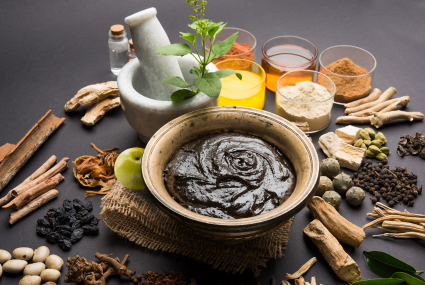
Pilonidal Sinus Treatment
Pilonidal Sinus is a small cyst or abscess that forms near the tailbone, often due to hair growth, friction, or infection. In Ayurveda, it is compared to Nadi Vrana, a sinus tract requiring cleansing and debridement. Treatments include internal herbal medications to purify the blood and reduce infection, while external therapies like ksharasutra (medicated thread application) help excise and heal the tract. Ayurveda also emphasizes dietary adjustments to improve digestion and immunity, along with personalized care to prevent recurrence. This natural, minimally invasive approach ensures effective healing and sustained relief.

Fissure-in-ano Treatment
Fissure-in-Ano is a painful condition characterized by a tear in the anal canal lining, often caused by constipation, hard stools, or strain during bowel movements. Ayurveda attributes it to aggravated Vata and Pitta doshas leading to dryness and inflammation. Treatment focuses on softening stools with herbal formulations like Avipathi Choornam and Triphala, applying soothing oils and ointments to aid healing, and performing local therapies such as sitz baths with medicated decoctions. Internal cleansing, diet rich in fiber, and Panchakarma therapies help restore digestive balance and prevent recurrence, providing a comprehensive and natural approach to long-term relief.


When the Gut and Anorectal Region Call for Care: An Ayurvedic Path to Digestive Comfort and Sustained Wellness
Digestive and anorectal conditions represent some of the most common health concerns globally with substantial impact on daily comfort, function, and quality of life. The spectrum is broad — from common functional disorders like IBS and chronic constipation through anorectal conditions like hemorrhoids, anal fissures, and fistulas affecting an estimated 50% of adults at some point in life, to broader gastrointestinal conditions. Modern lifestyle factors including prolonged sitting, processed diet patterns, inadequate fiber intake, stress, and sedentary habits have substantially increased the incidence of these conditions.
Common digestive and anorectal conditions include:
Anorectal conditions:
- Hemorrhoids/Piles (Arsha) — Internal, external, mixed; substantially common
- Anal fissure (Parikartika) — Acute and chronic
- Anal fistula (Bhagandara) — Complex condition requiring specialized management
- Pilonidal sinus
- Perianal abscess (supportive care)
- Rectal prolapse (supportive care)
- Anorectal abscess (supportive care)
- Chronic anal itching (Pruritus ani)
- Fecal incontinence (supportive care)
Digestive conditions:
- Chronic constipation (Vibandha) — Substantial impact on quality of life
- Irritable Bowel Syndrome (IBS) (Grahani) — Common functional disorder
- Inflammatory Bowel Disease (IBD) — Ulcerative colitis, Crohn's disease (supportive care)
- Functional dyspepsia (Ajirna)
- Chronic indigestion
- Acid reflux/GERD (Amlapitta)
- Peptic ulcer disease (Parinama Shoola)
- Hyperacidity
- Chronic diarrhea (Atisara)
- Diverticular disease (supportive care)
- Liver conditions — Fatty liver, hepatitis supportive
- Gallbladder conditions (supportive care)
- Chronic gastritis
- Bloating and flatulence
- Food intolerances
- Post-surgical gastrointestinal recovery
Modern medical management has substantially advanced with comprehensive evidence-based framework including specialized gastroenterology and proctology evaluation, comprehensive medical management of functional disorders, dietary and fiber-based approaches, antispasmodics and broader IBS-specific medications, proton pump inhibitors for acid-related conditions, specialized IBD therapies including biologics, comprehensive hemorrhoid management (medical management for early hemorrhoids, rubber band ligation, sclerotherapy, surgical hemorrhoidectomy for advanced disease), comprehensive fissure management (medical management, lateral internal sphincterotomy when indicated), comprehensive fistula management (fistulotomy, LIFT procedure, fistula plug, advancement flap, seton placement), and substantial recent therapeutic advances.
Classical Ayurveda addresses digestive and anorectal conditions through comprehensive framework recognizing the central role of Agni (digestive fire), Apana Vata (governing defecation and downward movement), and Purishavaha Srotas (excretory channels) — with substantial classical literature in Charaka Samhita, Sushruta Samhita, and Ashtanga Hridaya providing detailed framework. The classical understanding centers on the principle that disturbed Agni produces Ama (toxins) which combined with Vata vitiation produces digestive and anorectal pathology — providing comprehensive root-cause framework addressing fundamental factors rather than just symptoms.
The therapeutic framework provides comprehensive approach through Nidana Parivarjana (avoiding causative factors); Agni Deepana and Ama Pachana (digestive fire restoration); Shodhana through appropriate Panchakarma including Virechana for Pitta-predominant conditions and Basti for Vata-predominant conditions; specialized classical anorectal procedures including Kshara Karma (alkaline cautery), Kshara Sutra (alkaline thread therapy — recognized as gold-standard for fistula-in-ano), and Agnikarma (thermal cautery) for selected applications; comprehensive herbal therapy with classical formulations; comprehensive lifestyle integration; and coordination with continued gastroenterology and proctology care.
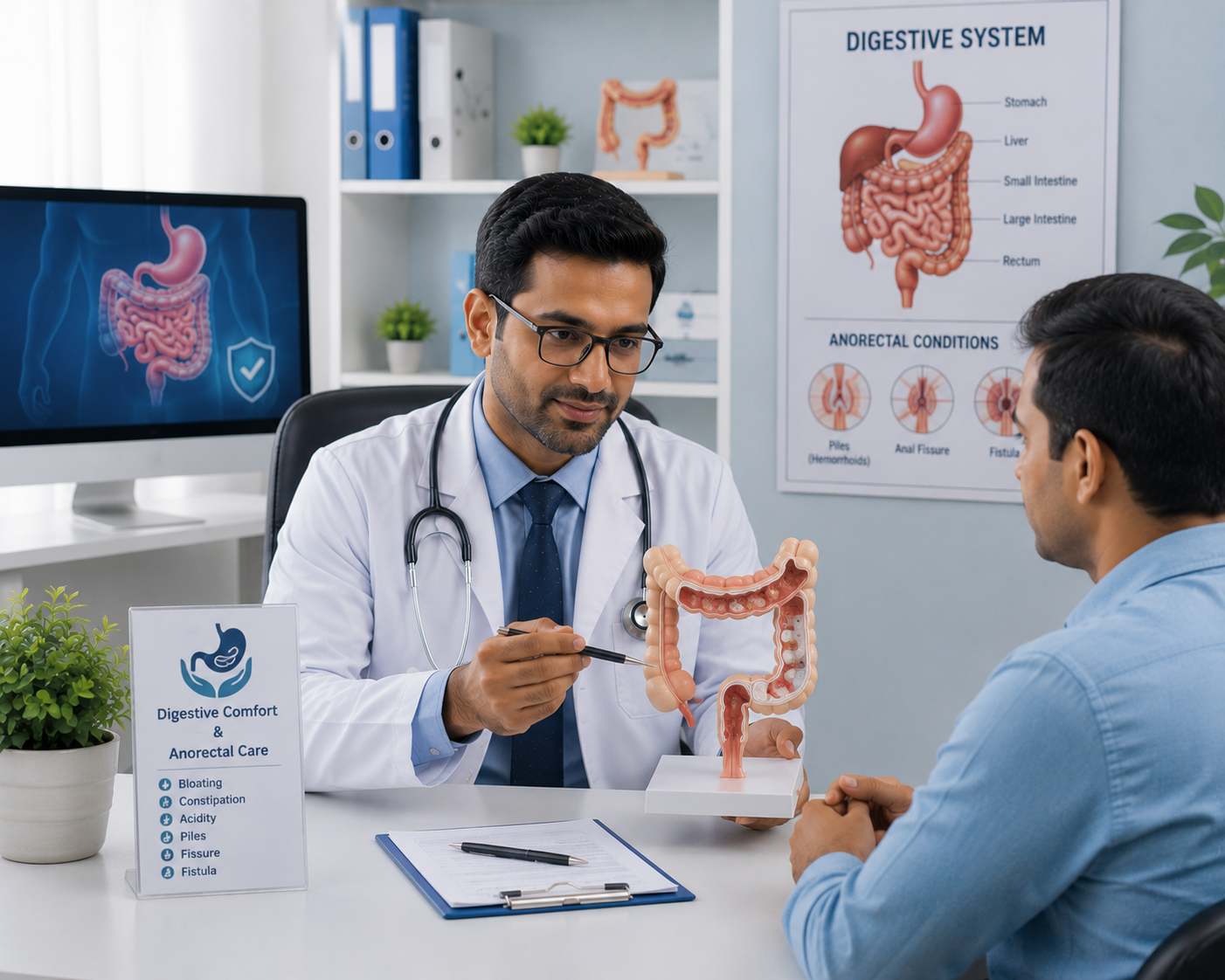
What is Digestive Comfort & Anorectal Care in Ayurveda?
Digestive and anorectal care in Ayurveda represents the comprehensive classical framework for digestive wellness, anorectal health, and management of conditions affecting the gastrointestinal tract from upper digestion through anorectal function.
Definition and characteristics:
- Comprehensive digestive and anorectal care framework
- Centered on Agni, Apana Vata, and Purishavaha Srotas
- Substantial classical literature foundation
- Comprehensive preventive and therapeutic approach
- Both acute and chronic condition applications
- Integration with continued conventional care
Anorectal conditions addressed:
Arsha (Hemorrhoids/Piles):
- Classical four subtypes based on doshic predominance
- Internal, external, and mixed patterns
- Bleeding and non-bleeding types
- Acute and chronic presentations
Parikartika (Anal Fissure):
- Acute and chronic fissures
- Posterior and anterior locations
- Sentinel pile and hypertrophied papilla with chronic fissures
Bhagandara (Anal Fistula):
- Classical five subtypes based on tract patterns
- Simple and complex fistulas
- Intersphincteric, transsphincteric, suprasphincteric, extrasphincteric patterns
Vibandha (Constipation):
- Acute and chronic constipation
- Functional and secondary causes
- Substantial classical recognition
Other anorectal:
- Pilonidal sinus
- Perianal abscess supportive
- Rectal prolapse supportive
- Chronic anal itching (Pruritus ani)
Digestive conditions addressed:
Grahani (IBS and related):
- Vataja, Pittaja, Kaphaja, Sannipataja patterns
- Comprehensive classical framework for functional bowel conditions
Ajirna (Indigestion):
- Four classical types (Ama, Vishtabdha, Vidagdha, Rasa Shesha)
- Detailed classical framework
Amlapitta (Acid Reflux/GERD/Hyperacidity):
- Substantial classical literature
- Adho-ga and Urdhva-ga patterns
Parinama Shoola (Peptic Ulcer):
- Comprehensive classical framework
- Detailed clinical observation
Atisara (Diarrhea):
- Six classical types
- Acute and chronic patterns
Inflammatory bowel conditions — Supportive care including ulcerative colitis and Crohn's
Liver conditions — Yakrit Vikara including fatty liver
Other digestive:
- Chronic gastritis
- Functional dyspepsia
- Bloating and flatulence
- Food intolerances
- Diverticular disease supportive
Core therapeutic frameworks:
- Nidana Parivarjana — Avoiding causes
- Agni Deepana and Ama Pachana — Foundational digestive optimization
- Shodhana Panchakarma — Virechana for Pitta-predominant, Basti for Vata-predominant
- Specialized classical anorectal procedures — Kshara Karma, Kshara Sutra, Agnikarma
- Shamana herbal therapy — Comprehensive classical pharmacopeia
- External therapies — Sitz baths, local applications, Avagaha Sweda
- Dietary and lifestyle integration
- Coordination with continued conventional care
Understanding Agni, Apana Vata, and Purishavaha Srotas: The Ayurvedic Framework for Digestive and Anorectal Health
The Ayurvedic understanding of digestive and anorectal health sits within comprehensive classical framework with substantial literature providing sophisticated framework.
Key concepts:
Agni as Foundational: Agni (digestive fire) is foundational to all health in Ayurveda — substantial classical literature on four states:
- Sama Agni (balanced) — optimal digestion
- Vishama Agni (irregular) — typically Vata-related
- Tikshna Agni (excessive) — typically Pitta-related with substantial relevance to acid disorders
- Manda Agni (sluggish) — typically Kapha-related
Agni status assessment fundamental to all digestive and anorectal treatment.
Ama Concept: Ama (toxins from inadequate digestion) considered fundamental cause of many chronic digestive conditions. Comprehensive approach to Ama clearing through digestive optimization and appropriate Panchakarma.
Apana Vata as Central: Apana Vata is the sub-dosha governing:
- Downward movement
- Defecation
- Urination
- Menstruation and labor
- Sexual function
Apana Vata dysfunction central to anorectal pathology and constipation.
Purishavaha Srotas: Classical excretory channel system carrying bowel function — disturbance produces various digestive disorders.
Annavaha Srotas: Classical channels carrying food and broader upper digestion.
Specific Doshic Dimensions in Anorectal Conditions:
Arsha (Hemorrhoids) Classical Framework: Four classical subtypes:
- Vataja Arsha — Dry, rough, painful, with substantial Vata symptoms
- Pittaja Arsha — With bleeding, burning, inflammation
- Kaphaja Arsha — Large, soft, mucus-producing, slow-growing
- Sannipataja — Combined patterns
Parikartika (Anal Fissure) — Substantial Vata-Pitta combined pathology
Bhagandara (Anal Fistula) — Complex tridoshic pathology with five classical subtypes
Vibandha (Constipation) — Apana Vata dysfunction central
Specific Doshic Dimensions in Digestive Conditions:
Vata-predominant (IBS-D, IBS-mixed, functional dyspepsia, Vata-type Grahani) Pitta-predominant (Amlapitta/GERD, peptic ulcer, Pitta-type Grahani, inflammatory conditions) Kapha-predominant (Kapha-type Grahani, fatty liver, sluggish digestion) Combined patterns common in complex chronic conditions
Disease Process (Samprapti): The classical anorectal pathogenesis:
- Improper diet leads to Agnimandya (weak digestion)
- Formation of Ama
- Vitiation of Apana Vata
- Disturbed bowel movement → constipation
- Straining causes:
- Swelling of veins → Piles
- Tear in anal canal → Fissure
- Infection and tract formation → Fistula
- Results in pain, bleeding, and discomfort
This classical framework anticipates modern understanding of constipation-strain-anorectal pathology cascade.
Predisposing Factors Classical Ayurveda Identifies:
Aharaja (Dietary):
- Agnimandya-promoting foods — heavy, hard-to-digest, processed
- Low fiber diet (substantial classical recognition)
- Excess spicy, dry, fried foods
- Excess junk food
- Incompatible food combinations (Viruddha Ahara)
- Inadequate fluid intake
- Irregular eating habits
Viharaja (Lifestyle):
- Suppression of natural urges (Vegadharana) — substantial classical recognition with specific relevance to bowel urge suppression
- Sedentary lifestyle with substantial impact
- Prolonged sitting (substantial classical recognition)
- Straining during defecation
- Inadequate exercise
Manasika (Mental):
- Stress affecting Apana Vata
- Anxiety
- Suppressed emotions
Other:
- Pregnancy with substantial relevance to hemorrhoids
- Obesity
- Aging with natural Vata aggravation
- Family history
This shapes the Ayurvedic approach to digestive and anorectal care: comprehensive Nidana Parivarjana; Agni Deepana and Ama Pachana as foundational; dosha-specific approach; specialized classical anorectal procedures including Kshara Karma, Kshara Sutra, Agnikarma; comprehensive Panchakarma when indicated; comprehensive herbal therapy; external therapies; comprehensive dietary and lifestyle integration; coordination with continued gastroenterology and proctology care.
The 3 Stages of Ayurvedic Treatment for Digestive and Anorectal Conditions
1. Preparation (Purva Karma) — Typically 3-7 days
Comprehensive assessment including detailed digestive and anorectal history (specific conditions, duration, severity, current symptoms, bowel patterns), current gastroenterology/proctology evaluation and treatment context including all medications, recent specialist visits, prior surgical interventions when applicable, comorbidities, dietary patterns, lifestyle factors with attention to sedentary patterns and bowel urge suppression, stress levels, and constitutional profile.
Gastroenterology and proctology coordination essential — current treatment confirmed, sharing of treatment approach.
Critical screening:
- Stable current condition without acute deterioration requiring urgent care
- No acute severe rectal bleeding requiring urgent evaluation
- No suspected colorectal malignancy — rectal bleeding always requires appropriate evaluation to exclude malignancy
- No acute severe IBD flare requiring urgent management
- No acute bowel obstruction
- No acute appendicitis or surgical emergency
- No active sepsis from perianal abscess requiring urgent surgical drainage
- Confirmed appropriate baseline evaluation including colonoscopy when indicated for substantial conditions
Deepana-Pachana for digestive function. Initial constitutional support matched to specific condition. Initial dietary modifications. Foundational lifestyle measures including never suppressing bowel urge (Vegadharana avoidance) absolutely essential, fiber and hydration optimization, regular bowel habits establishment.
2. Core Treatment (Pradhana Karma) — Typically 14-21 days
Primary therapies focus on five coordinated lines:
Agni Deepana and Ama Pachana — Foundational Approach:
- Trikatu for foundational Agni support
- Chitrakadi Vati for digestive enhancement
- Hingvastaka Churna for digestive support
- Panchakola Churna for deeper digestive
- Specific Pachana herbs
- Light, warm, easily digestible diet
Shodhana Therapy Matched to Doshic Patterns:
Virechana for Pitta-predominant conditions:
- Mild purgation relieving constipation
- Substantial value for hemorrhoids with bleeding
- Clears Pitta and toxins
- Liver and broader benefits
Basti for Vata-predominant conditions:
- Most effective for Apana Vata regulation
- Regulates bowel movement
- Particularly valuable for chronic constipation, IBS-D, post-surgical recovery
- Multiple types matched to needs
Specialized Classical Anorectal Procedures:
Kshara Karma (Alkaline Cautery):
- Application of alkaline medicine
- Used for piles and certain conditions
- Substantial classical use
- Requires specialized expertise
Kshara Sutra Therapy — The Gold-Standard Ayurvedic Treatment:
- Kshara Sutra is the gold-standard Ayurvedic treatment for fistula-in-ano (Bhagandara) with substantial classical use and extensive modern validation
- Medicated thread treated with specific alkalis (typically Apamarga Kshara) inserted through fistula tract
- Provides gradual cutting and healing simultaneously
- Minimal recurrence compared to many surgical alternatives
- Substantial sphincter preservation
- Multiple weekly thread changes typically required over 4-8 weeks
- WHO and ICMR-recognized procedure with substantial evidence base
- Requires substantial specialized expertise
Agnikarma (Thermal Cautery):
- Selected applications
- Substantial classical use
- Requires specialized expertise
Comprehensive Shamana Therapy (Internal Medicines):
For Piles (Arsha):
- Arshoghni Vati — classical hemorrhoid formulation
- Triphala Guggulu — comprehensive support
- Abhayarishta — gentle purgative and broader benefits
- Chiruvilwadi Kashayam — substantial classical use
For Fissure (Parikartika):
- Gandhaka Rasayana — substantial classical use
- Jatyadi Ghrita for local application with substantial healing applications
- Triphala for foundational support
For Fistula (Bhagandara):
- Triphala for foundational support
- Guggulu preparations
- Specific antimicrobial herbs
For Constipation (Vibandha):
- Triphala Churna — foundational gentle approach
- Eranda Taila (castor oil) — substantial classical use
- Avipattikar Churna for combined patterns
- Abhayarishta
For IBS (Grahani):
- Kutaja preparations — substantial Grahani applications
- Kutajarishta
- Bilwadi Kashayam
- Bilwa-based preparations
- Specific Grahani formulations
For Amlapitta (GERD/Acid):
- Avipattikar Churna — substantial classical use
- Kamadudha Rasa
- Praval Pishti
- Yashtimadhu preparations
- Shankha Bhasma
For Peptic Ulcer (Parinama Shoola):
- Yashtimadhu preparations with substantial healing applications
- Avipattikar Churna
- Shatavari preparations
- Specific ulcer-supportive formulations
Comprehensive External Therapies:
Sitz Bath (Avagaha Sweda):
- With herbal decoctions
- Substantial benefits for anorectal conditions
- Daily warm sitz bath
- Specific decoctions: Triphala, Panchavalkala, broader preparations
Local applications:
- Jatyadi Ghrita — substantial classical wound-healing application
- Pilex preparations and broader local applications
- Specific medicated oils
- Lepa (herbal paste) applications
Comprehensive Lifestyle Integration with Continued Care:
- Continued essential medications absolutely essential when prescribed
- High-fiber diet essential
- Adequate hydration essential
- Regular bowel habits
- Never suppressing bowel urge
- Regular exercise
- Avoiding prolonged sitting
- Stress management
3. Rejuvenation (Paschat Karma) — Continued home regimen
Sustained Agni support, continued constitutional approach, continued lifestyle integration, continued recurrence prevention, periodic clinical follow-up, continued specialist coordination. Long-term framework — particularly important for recurrence-prone conditions like piles, fissures, and chronic constipation.
The 5 Core Therapies for Digestive and Anorectal Care Explained
1. Kshara Sutra — The Gold-Standard Ayurvedic Treatment for Fistula-in-Ano Kshara Sutra represents the most clinically valuable Ayurvedic intervention for digestive and anorectal care and the gold-standard Ayurvedic treatment for fistula-in-ano (Bhagandara) with substantial classical use and extensive modern validation through randomized controlled trials and clinical studies. Procedure: medicated thread treated with specific alkalis (typically Apamarga Kshara with Snuhi Ksheera and Haridra) inserted through fistula tract providing gradual simultaneous cutting and healing through controlled chemical action. Critical advantages over conventional surgical fistulotomy: substantially lower recurrence rates documented in multiple studies; substantial sphincter preservation with reduced incontinence risk compared to extensive fistulotomy; outpatient procedure without need for general anesthesia in most cases; applicable to complex fistulas including high transsphincteric, suprasphincteric, and recurrent fistulas where conventional surgery has substantial risks; substantial healing through controlled inflammation and tissue regeneration. Procedure protocol: initial assessment and fistula mapping; insertion of medicated thread; weekly thread changes typically required over 4-8 weeks with progressive cutting and healing; gradual fistula closure from base; substantial monitoring throughout. Modern recognition: WHO recognition, ICMR (Indian Council of Medical Research) recognition, substantial published evidence base, growing international recognition. Specific indications: simple and complex anal fistulas, recurrent fistulas after failed conventional surgery, high transsphincteric and suprasphincteric fistulas, pilonidal sinus, certain other conditions. Critical requirements: substantial specialized practitioner expertise; appropriate clinical infrastructure; appropriate patient selection; coordination with colorectal surgeons when needed for complex cases. WellnessLoka Kerala centres provide expert Kshara Sutra capability.
2. Kshara Karma and Specialized Classical Anorectal Procedures Comprehensive Kshara Karma (alkaline cautery) and broader specialized classical anorectal procedures provide substantial value for selected anorectal conditions with substantial classical use. Kshara Karma: application of specific alkaline medicines (typically Apamarga Kshara or specific Kshara preparations) directly to lesions providing controlled chemical destruction and healing; substantial classical use for internal hemorrhoids particularly with substantial recognition; sentinel piles; certain fissure conditions; specific other applications. Mechanisms: controlled alkaline destruction of pathological tissue followed by healing; avoiding need for surgical excision in selected cases; outpatient procedure. Agnikarma (Thermal Cautery): classical thermal cautery application in selected conditions; substantial classical use; specific applications. Pratisaraneeya Kshara vs Pakshalya Kshara: classical distinction between application methods. Combined approach: specialized procedures combined with internal Shamana therapy, external therapies, and lifestyle integration providing comprehensive treatment. Critical requirements: substantial specialized practitioner expertise; appropriate clinical infrastructure including sterile technique; appropriate patient selection. Coordination with colorectal surgery for substantial conditions requiring surgical management — substantial hemorrhoids may require rubber band ligation, sclerotherapy, or hemorrhoidectomy; substantial fissures may require sphincterotomy when chronic and refractory. Comprehensive integrative approach — Ayurvedic specialized procedures complement rather than replace continued specialist evaluation for substantial conditions. WellnessLoka Kerala centres provide expert specialized anorectal procedures.
3. Comprehensive Agni Restoration and Shodhana Approach Comprehensive Agni Deepana and Ama Pachana with appropriate Shodhana provides foundational therapeutic approach for digestive and anorectal conditions — addressing root-cause factors rather than just symptoms. Comprehensive Agni restoration: Trikatu (ginger, pippali, black pepper) for foundational Agni support; Chitrakadi Vati for digestive enhancement; Hingvastaka Churna for digestive support particularly valuable for Vata patterns; Panchakola Churna for deeper digestive support; specific Agni-supportive preparations matched to individual patterns. Comprehensive Ama clearing: appropriate Pachana herbs; dietary modification with light easily digestible foods; avoiding Ama-promoting factors. Shodhana matched to doshic predominance: Virechana (therapeutic purgation) for Pitta-predominant conditions including hemorrhoids with bleeding, GERD, peptic ulcer, fatty liver, broader Pitta digestive conditions — substantial classical use with effective Pitta clearing and liver benefits; Basti for Vata-predominant conditions — most effective for Apana Vata regulation with multiple Vasti types: Matra Basti for gentle sustained therapy, Anuvasana Basti with appropriate oils, Niruha Basti with appropriate decoctions, Yapana Basti for chronic conditions, Yoga Basti sequence for intensive intervention; Basti particularly valuable for chronic constipation, IBS-D and mixed, post-surgical bowel recovery, broader chronic Vata digestive conditions. Appropriate combination of Virechana and Basti for combined Vata-Pitta patterns common in many chronic conditions. Comprehensive Pachakarma capability essential. WellnessLoka centres provide expert Agni restoration and Shodhana.
4. Comprehensive Shamana Therapy with Condition-Specific Classical Formulations Comprehensive Shamana therapy with classical formulations specifically matched to individual conditions provides substantial value across the digestive and anorectal condition spectrum. For hemorrhoids (Arsha): Arshoghni Vati as classical hemorrhoid formulation; Triphala Guggulu for comprehensive support; Abhayarishta as gentle purgative with substantial classical use; Chiruvilwadi Kashayam with substantial Arsha applications; Pilex type preparations; specific bleeding hemorrhoid preparations including Bolaparpati for bleeding. For anal fissure (Parikartika): Gandhaka Rasayana with substantial classical use; Jatyadi Ghrita for local application with substantial wound-healing applications; Triphala for foundational support; Yashtimadhu Ghrita for additional healing. For anal fistula (Bhagandara): Triphala for foundational support; Guggulu preparations including Kaishore Guggulu; specific antimicrobial herbs; combined with Kshara Sutra for definitive treatment. For chronic constipation (Vibandha): Triphala Churna as foundational gentle approach with substantial classical use; Eranda Taila (castor oil) with substantial classical applications; Avipattikar Churna for combined patterns; Abhayarishta for gentle sustained support; Sukumara Ghrita for Vata-predominant constipation. For IBS (Grahani): Kutaja preparations with substantial Grahani applications; Kutajarishta; Bilwadi Kashayam; Bilwa Avaleha for substantial Grahani support; specific Grahani formulations matched to individual subtype (Vataja, Pittaja, Kaphaja, Sannipataja). For Amlapitta/GERD: Avipattikar Churna with substantial classical use; Kamadudha Rasa; Praval Pishti; Yashtimadhu preparations; Shankha Bhasma. For peptic ulcer (Parinama Shoola): Yashtimadhu preparations with substantial healing applications and emerging modern evidence; Avipattikar Churna; Shatavari preparations. Comprehensive individualized selection essential through expert practitioner assessment. WellnessLoka centres provide authentic preparations.
5. Comprehensive Lifestyle Integration with Avagaha Sweda, Dietary Approach, and Coordination with Continued Care Comprehensive lifestyle integration with Avagaha Sweda (sitz bath), comprehensive dietary approach, and coordination with continued gastroenterology and proctology care provides foundation for sustained digestive and anorectal wellness. Avagaha Sweda (Herbal Sitz Bath): substantial classical use with comprehensive benefits for anorectal conditions; warm herbal decoction bath providing soothing, anti-inflammatory, and healing effects; standard preparations using Triphala decoction, Panchavalkala (five-bark decoction), specific medicated decoctions; daily warm sitz bath for 15-20 minutes providing substantial relief; particularly valuable for hemorrhoids, fissures, post-surgical recovery, post-Kshara Sutra recovery, broader anorectal conditions. Local applications: Jatyadi Ghrita with substantial classical wound-healing applications; specific medicated oils; Lepa (herbal paste) applications matched to conditions. Comprehensive dietary approach: high-fiber diet absolutely essential for digestive and anorectal health — substantial classical recognition; whole grains including substantial classical use of broken wheat (Dalia), red rice, broader whole grains; abundant vegetables including specific bowel-supportive vegetables (radish, leafy greens, papaya, broader); fresh fruits particularly papaya with substantial classical use, prunes, figs, ripe banana; adequate appropriate hydration essential — typically warm water through day; buttermilk with substantial classical use for digestive support; ghee in moderation for lubrication with substantial classical use; specific Agni-supportive spices (ginger, cumin, fennel, coriander, ajwain). Foods to avoid: spicy and fried foods particularly for inflammatory conditions; dry and processed foods; excess tea/coffee; alcohol; specific individual triggers; refined foods. Critical lifestyle measures: never suppressing bowel urge (Vegadharana avoidance) absolutely essential with substantial classical recognition; regular bowel habits with specific time preferably morning; avoiding straining during defecation; comfortable toileting position with knees elevated (substantial benefit); regular exercise essential for bowel health with substantial impact; avoiding prolonged sitting with periodic standing/walking essential for sedentary workers; specific yoga practices including Malasana (squat pose) particularly valuable for bowel health, Pavanamuktasana (wind-relieving pose), Vajrasana (after meals), specific seated practices. Comprehensive stress management — substantial impact on Apana Vata and digestive function; meditation; pranayama. Comprehensive coordination with continued conventional care: continued essential medications throughout; appropriate specialist follow-up; colonoscopy and broader evaluation when indicated particularly for rectal bleeding which always requires evaluation; surgical coordination when substantial conditions require surgical intervention; honest framing about integrative role. WellnessLoka programs structure comprehensive lifestyle integration.
How Long Should an Ayurvedic Treatment Program for Digestive and Anorectal Conditions Last?
| Duration | Therapeutic Benefit |
| 7–14 days | Initial protocols, established Agni restoration, foundational interventions, dietary establishment |
| 14–21 days | Comprehensive constitutional support, sustained therapy, Basti or Virechana when indicated |
| 21–28 days | Extended program with complete Panchakarma and comprehensive Paschat Karma |
| Kshara Sutra fistula treatment | Typically 4-8 weeks with weekly thread changes |
Book Consultation
Benefits of an Ayurvedic Treatment Retreat for Digestive and Anorectal Conditions
| Physical Benefits | Functional Benefits | Long-Term Impact |
| Symptom relief | Regular bowel function | Sustained digestive wellness |
| Better digestion | Better daily comfort | Foundation for recurrence prevention |
| Better wound healing | Better quality of life | Better long-term anorectal health |
| Better overall vitality | Reduced pain and discomfort | Comprehensive integrative care framework |
Why Kerala is the Best Place for Digestive Comfort & Anorectal Care
An Ayurvedic digestive and anorectal care retreat in Kerala, India offers the most clinically authentic environment for comprehensive treatment of these common conditions alongside continued essential gastroenterology and proctology care.
- Experienced physicians with specific expertise in classical digestive and anorectal Ayurveda
- BAMS and MD Ayurveda-certified doctors with specialised training in digestive and anorectal conditions including Arsha, Parikartika, Bhagandara, Grahani, Amlapitta, and broader conditions
- Specialised MS Ayurveda (Shalya Tantra) surgeons with expertise in classical Ayurvedic surgical procedures including Kshara Sutra
- Specialised practitioner training in Kshara Sutra — the gold-standard Ayurvedic treatment for fistula-in-ano with substantial expertise required including alkaline thread preparation, proper insertion technique, weekly thread changes over 4-8 weeks, monitoring, and aftercare
- Specialised practitioner training in Kshara Karma (alkaline cautery) for hemorrhoids and selected anorectal conditions
- Specialised practitioner training in Agnikarma for selected applications
- Specialised practitioner training in Basti Chikitsa including Yapana Basti for chronic conditions
- Specialised practitioner training in Virechana for Pitta-predominant conditions
- Authentic in-house preparation of Apamarga Kshara and broader Kshara preparations following classical methodology essential for Kshara Sutra and Kshara Karma
- Authentic in-house preparation of Jatyadi Ghrita — the foundational wound-healing classical preparation with substantial use for fissures, post-surgical recovery, broader applications
- Authentic preparation of classical anorectal formulations — Arshoghni Vati, Triphala Guggulu, Abhayarishta, Chiruvilwadi Kashayam, Gandhaka Rasayana
- Authentic preparation of classical digestive formulations — Triphala Churna, Avipattikar Churna, Kutajarishta, Bilwadi Kashayam, Hingvastaka Churna, Trikatu, Chitrakadi Vati, Panchakola Churna, Kamadudha Rasa, Yashtimadhu preparations, Shankha Bhasma — using authentic methods and fresh herbs
- Authentic preparation of medicated oils for Basti and external applications
- Authentic preparation of herbal decoctions for Avagaha Sweda including Triphala and Panchavalkala preparations
- Proper Kshara Sutra facilities with appropriate clinical infrastructure including sterile technique, outpatient procedure capability, and specialized aftercare
- Proper Panchakarma facilities for comprehensive Basti and Virechana
- Proper Avagaha Sweda (sitz bath) facilities with appropriate infrastructure
- WHO and ICMR recognition of Kshara Sutra providing substantial credibility for the procedure
- Long-established Kerala tradition of comprehensive digestive and anorectal Ayurveda
- Senior-friendly accommodation for older patients with age-related digestive concerns
- Capacity for emergency medical escalation with clear protocols for any acute concerns
- Coordination capability with continued gastroenterology and proctology care including continued essential treatments and appropriate surgical referrals when needed
- Capacity for sustained long-term care relationships through chronic condition management
- Capacity for comprehensive lifestyle integration including high-fiber dietary preparation, hydration optimization, regular bowel habit establishment, exercise programs, yoga instruction, stress management
- Capacity for integrated cardiovascular and metabolic management given substantial digestive-cardiovascular associations
- Discretion and sensitivity throughout treatment
Sri Lanka offers complementary tropical healing environment with Ayurvedic expertise in chronic conditions, while Bali provides wellness-oriented treatment retreats integrating Ayurvedic care with holistic wellness particularly valuable for functional digestive conditions and broader lifestyle integration. For specialised digestive and anorectal Ayurveda with comprehensive Kshara Sutra capability and authentic classical formulation preparation, Kerala offers the deepest tradition.
Digestive and Anorectal Care Treatment Retreats by Location and Recommended Centres
Kerala, India — The most clinically authentic destination for classical digestive and anorectal Ayurveda with established tradition including specialised Kshara Sutra capability as gold-standard fistula treatment with substantial expertise, specialised Kshara Karma capability for hemorrhoids and anorectal conditions, comprehensive Basti capability essential for digestive disorders, specialised Virechana expertise for Pitta-predominant conditions, authentic Apamarga Kshara and Jatyadi Ghrita preparation, authentic preparation of classical anorectal and digestive formulations, proper Kshara Sutra facilities with appropriate clinical infrastructure, proper Avagaha Sweda facilities, WHO and ICMR recognition of Kshara Sutra, senior-friendly accommodation, emergency medical escalation capability, and the deepest tradition of comprehensive digestive and anorectal Ayurveda. Alleppey • Kovalam • Kumarakom • Wayanad • Palakkad
Sri Lanka — Coastal Ayurveda treatment retreats with comprehensive supportive care for digestive conditions in serene tropical environment. Wadduwa • Weligama • Sigiriya • Kosgoda • Bentota
Bali, Indonesia — Wellness treatment retreats integrating Ayurvedic care with holistic wellness restructuring, particularly valuable for functional digestive conditions and broader lifestyle integration. Ubud • Nusa Dua • Candidasa • Lovina
WellnessLoka connects you with verified centres across these destinations offering genuine digestive and anorectal Ayurvedic expertise, comprehensive Kshara Sutra capability essential for fistula treatment, specialised Kshara Karma and broader specialized procedure capability, comprehensive Panchakarma capability, authentic classical formulation preparation, proper specialized facilities, senior-friendly accommodation, capacity for emergency medical escalation, absolute commitment to coordination with continued gastroenterology and proctology care including appropriate surgical referrals when needed, and clear understanding of the integrative role.
Who Should Consider an Ayurvedic Digestive and Anorectal Care Treatment Retreat
Patients with anal fistula (Bhagandara) — Comprehensive Kshara Sutra treatment as gold-standard Ayurvedic approach with substantial advantages over conventional fistulotomy for many cases.
Patients with recurrent anal fistula after failed conventional surgery — Particularly valuable Kshara Sutra approach.
Patients with complex anal fistulas (high transsphincteric, suprasphincteric) — Substantial sphincter preservation advantage with Kshara Sutra.
Patients with hemorrhoids/piles (Arsha) — Comprehensive integrative approach including Kshara Karma for selected applications.
Patients with anal fissure (Parikartika) — Comprehensive integrative approach including Jatyadi Ghrita local application.
Patients with pilonidal sinus — Kshara Sutra application.
Patients with chronic constipation (Vibandha) — Comprehensive integrative approach including Basti and lifestyle integration.
Patients with IBS (Grahani) — Comprehensive subtype-specific integrative approach.
Patients with chronic indigestion — Comprehensive Agni restoration approach.
Patients with GERD/acid reflux/hyperacidity (Amlapitta) — Comprehensive integrative approach.
Patients with peptic ulcer (Parinama Shoola) — Comprehensive integrative approach alongside continued conventional treatment.
Patients with fatty liver — Comprehensive integrative approach.
Patients with IBD in stable phases — Comprehensive supportive integrative approach alongside continued specialist care.
Patients with chronic diarrhea — Comprehensive integrative approach.
Patients post-surgical bowel recovery — Comprehensive supportive integrative approach.
Patients with combined digestive and metabolic conditions — Holistic integrative approach.
Patients with substantial lifestyle factors contributing — Comprehensive lifestyle integration.
Patients seeking constitutional approach — Comprehensive Ayurvedic framework.
Patients with chronic stress contributing to digestive symptoms — Comprehensive stress management.
Patients seeking long-term integrative digestive wellness philosophy — Holistic approach.
Who Should Approach Treatment with Caution
Ayurvedic care for digestive and anorectal conditions is genuinely valuable but appropriate medical evaluation and continued gastroenterology and proctology coordination are essential. Ayurvedic retreat-based care should be deferred or replaced by urgent specialist care in cases involving:
Acute severe rectal bleeding — Requires urgent evaluation including colonoscopy.
Suspected colorectal malignancy — Rectal bleeding in adults always requires appropriate evaluation including colonoscopy to exclude colorectal cancer — substantially common and serious cause; never assume rectal bleeding is benign hemorrhoidal without appropriate evaluation.
Suspected GI malignancy — Requires urgent oncology evaluation.
Active acute IBD flare — Requires urgent specialized management.
Acute bowel obstruction — Requires urgent surgical evaluation.
Acute appendicitis — Requires urgent surgical evaluation.
Active sepsis from perianal abscess — Requires urgent surgical drainage.
Acute severe peptic ulcer bleeding — Requires urgent endoscopy.
Active severe Crohn's disease — Requires specialized IBD management.
Severe complex fistulas with substantial sphincter involvement — May require specialized colorectal surgical evaluation alongside Kshara Sutra consideration.
Patients with substantial unrealistic expectations — Honest counseling about realistic outcomes.
Patients planning to discontinue essential medications — Strongly discouraged.
Patients without baseline gastroenterology evaluation for substantial conditions — Should have appropriate evaluation before retreat-based care; rectal bleeding always requires evaluation.
Pregnancy with substantial digestive conditions — Requires specialized coordination.
Choosing the Right Treatment Retreat for Digestive and Anorectal Care
Qualified physicians with digestive and anorectal Ayurveda expertise — BAMS or MD Ayurveda-credentialed doctors with specialised training.
Specialised MS Ayurveda (Shalya Tantra) surgeons — Essential for Kshara Sutra and broader specialized procedures.
Specialised practitioner training in Kshara Sutra — Essential given gold-standard role for fistula.
Specialised practitioner training in Kshara Karma, Agnikarma, Basti, and Virechana — Essential for comprehensive specialized care.
Authentic in-house Apamarga Kshara and Jatyadi Ghrita preparation — Following classical methodology.
Authentic preparation of classical anorectal and digestive formulations — With quality assurance.
Proper Kshara Sutra facilities with appropriate clinical infrastructure — Essential including sterile technique.
Proper Panchakarma and Avagaha Sweda facilities — For comprehensive approach.
Capacity for emergency medical escalation — Clear protocols.
Coordination capability with continued gastroenterology and proctology care — Essential including appropriate surgical referrals.
Capacity for sustained long-term care relationships — For chronic conditions and recurrence prevention.
Honest framing — Centres clearly understanding integrative role.
Clear continuity-of-care planning — Detailed home regimens and ongoing coordination.
How WellnessLoka Helps You Choose the Right Ayurveda Treatment Retreat for Digestive Comfort & Anorectal Care
Choosing the right treatment retreat for digestive and anorectal care benefits enormously from genuine guidance. This is a particularly important field of Ayurveda with substantial classical expertise including specialized surgical procedures requiring substantial specialized training — particularly Kshara Sutra which is the gold-standard Ayurvedic treatment for fistula-in-ano with WHO and ICMR recognition, substantial published evidence base, and substantial advantages over conventional fistulotomy in many cases. The right program depends on accurate identification of specific conditions, appropriate therapy selection particularly Kshara Sutra when indicated for fistula, and matching to centres with genuine expertise and absolute coordination with continued gastroenterology and proctology care including appropriate surgical referrals when needed. WellnessLoka exists to ensure that patients can make this decision with full information, genuine guidance, and complete confidence.
Access to Verified Retreat Centres Every centre listed on WellnessLoka for digestive and anorectal care has been independently assessed for physician credentials including specialised MS Ayurveda (Shalya Tantra) surgeons essential for Kshara Sutra and broader specialized procedures, specialised practitioner training in Kshara Sutra as gold-standard Ayurvedic treatment for fistula-in-ano with substantial expertise required including alkaline thread preparation, proper insertion technique, weekly thread changes over 4-8 weeks, monitoring, and aftercare, specialised practitioner training in Kshara Karma (alkaline cautery) for hemorrhoids and selected anorectal conditions, specialised practitioner training in Agnikarma for selected applications, specialised practitioner training in Basti Chikitsa including Yapana Basti for chronic conditions, specialised Virechana expertise for Pitta-predominant conditions, authentic in-house preparation of Apamarga Kshara and broader Kshara preparations following classical methodology essential for Kshara Sutra and Kshara Karma, authentic in-house preparation of Jatyadi Ghrita as foundational wound-healing classical preparation with substantial applications, authentic preparation of classical anorectal formulations including Arshoghni Vati, Triphala Guggulu, Abhayarishta, Chiruvilwadi Kashayam, Gandhaka Rasayana, authentic preparation of classical digestive formulations including Triphala Churna, Avipattikar Churna, Kutajarishta, Bilwadi Kashayam, Hingvastaka Churna, Trikatu, Chitrakadi Vati, Panchakola Churna, Kamadudha Rasa, Yashtimadhu preparations, Shankha Bhasma, authentic preparation of medicated oils for Basti and external applications, proper Kshara Sutra facilities with appropriate clinical infrastructure including sterile technique and outpatient procedure capability, proper Panchakarma facilities for comprehensive Basti and Virechana, proper Avagaha Sweda facilities with appropriate infrastructure for sitz baths, WHO and ICMR recognition of Kshara Sutra providing substantial credibility, senior-friendly accommodation for older patients, capacity for emergency medical escalation with clear protocols, absolute commitment to coordination with continued gastroenterology and proctology care including appropriate surgical referrals when needed for substantial conditions like complex fistulas, advanced hemorrhoids requiring procedural management, or suspected malignancy requiring oncology evaluation, capacity for sustained long-term care relationships, and clear understanding of the integrative role. We list only centres where authentic specialized protocols are genuinely practised with classical depth and appropriate clinical infrastructure.
Free Pre-Retreat Consultation with Our Ayurvedic Doctor Before you choose a retreat, WellnessLoka offers a complimentary consultation with our in-house Ayurvedic consultant. This consultation reviews your specific digestive and anorectal context (specific conditions, duration, severity, current symptoms including any bleeding patterns, prior treatments and response, current medications, prior surgical interventions when applicable), prior gastroenterology and proctology evaluation essential particularly when rectal bleeding has been present to ensure appropriate evaluation has excluded colorectal malignancy, comorbidities, dietary patterns, lifestyle factors, stress levels, and constitutional profile. A critical part of this consultation is screening for any features warranting urgent specialist evaluation including acute severe rectal bleeding, suspected colorectal malignancy, active acute IBD flare, suspected sepsis from perianal abscess, or other concerning features that may make retreat-based care inappropriate currently — and ensuring appropriate baseline evaluation has been completed for substantial conditions. Based on the assessment, we match you with the retreat centre and program duration best suited for your specific clinical context. It is purely a guidance consultation.
Transparent Centre Comparison WellnessLoka provides clear, honest information about each listed centre — physician qualifications including MS Ayurveda Shalya Tantra surgeons, Kshara Sutra capability and experience, broader specialized procedure capability, classical formulation preparation, Avagaha Sweda facilities, accommodation features, program structure, and pricing — allowing comparison across Kerala, Sri Lanka, and Bali with full clarity.
Best Price Guarantee Through our strong, long-standing relationships with partner centres, you benefit from exclusive partner pricing that is always lower than booking directly. You receive the most authentic care without paying more for it.
Retreats for Every Budget From luxury wellness resorts to affordable, authentic healing centres, WellnessLoka helps you find a digestive and anorectal care retreat that aligns perfectly with your comfort level and budget — without ever compromising on the specialised expertise this care fundamentally benefits from.
Treatment is in Expert Hands Once you arrive at your chosen retreat, your treatment program is fully designed and managed by the qualified Ayurvedic physicians at that centre including MS Ayurveda Shalya Tantra surgeons for specialized procedures with deep training in classical digestive and anorectal Ayurveda and direct, hands-on familiarity with Kshara Sutra, Kshara Karma, Panchakarma, and broader classical therapies your program involves. Treatment unfolds under continuous qualified supervision with appropriate sensitivity to digestive and anorectal patient needs and unwavering coordination with your continued essential gastroenterology and proctology care.
Local Support Team Our on-ground experts assist you at every step from first enquiry through retreat completion — resolving any issues and ensuring smooth, safe experience with appropriate sensitivity to digestive and anorectal patient needs.
End-to-End Booking Support Full administrative and logistical support with appropriate sensitivity — ensuring smooth process so you focus entirely on preparing for your healing program.
Why Travellers Trust WellnessLoka WellnessLoka is rated 4.9? on Google, with verified reviews from wellness travellers from 28+ countries, backed by over a decade of expertise. Our dedicated support team is available 24×7 with appropriate sensitivity to digestive and anorectal care complexity.
Begin Your Healing Journey
Digestive and anorectal conditions affect substantial proportion of adults globally with substantial impact on daily comfort, function, and quality of life. Modern gastroenterology and proctology have substantially advanced with comprehensive evidence-based framework. Yet substantial therapeutic gaps remain for many patients seeking comprehensive integrative approaches particularly for fistula-in-ano where conventional fistulotomy carries substantial recurrence and continence risks.
Classical Ayurvedic care offers genuinely meaningful integrative contributions through comprehensive framework centered on Agni, Apana Vata, and Purishavaha Srotas with substantial classical literature. The therapeutic framework centers on Kshara Sutra as gold-standard Ayurvedic treatment for fistula-in-ano with WHO and ICMR recognition and substantial published evidence; specialized classical anorectal procedures including Kshara Karma and Agnikarma; comprehensive Agni restoration and Shodhana approach through appropriate Panchakarma; comprehensive Shamana therapy with condition-specific classical formulations; comprehensive lifestyle integration with Avagaha Sweda, dietary approach, and coordination with continued gastroenterology and proctology care.
Ayurvedic care complements rather than replaces continued essential gastroenterology and proctology care including appropriate evaluation (colonoscopy when indicated), conventional medical management, and surgical interventions when indicated. Rectal bleeding always requires appropriate evaluation to exclude colorectal malignancy. Continued essential medications throughout integrative care when applicable.
Whether you choose a treatment retreat in Kerala, Sri Lanka, or Bali — with Kerala offering particular depth in classical digestive and anorectal Ayurveda particularly Kshara Sutra — Ayurvedic care for digestive and anorectal conditions offers a thoughtful, deeply integrative path to enhanced digestive comfort, symptom relief, sustained wellness, and substantial quality of life enhancement alongside continued essential gastroenterology and proctology care.


