

When the Nerve Cries Out: A Classical Ayurvedic Journey Through Vata Vyadhi Restoration and Radicular Recovery
Radiculopathy represents one of the most clinically significant neurological pain syndromes globally with substantial documented prevalence affecting an estimated 3-5% of adults with substantial impact on daily activities, work productivity, sleep, and quality of life. Characterised by nerve root compression or irritation typically from disc herniation, spinal stenosis, foraminal narrowing, spondylolisthesis, or other structural causes — producing characteristic radiating pain along specific nerve distributions with potential numbness, tingling, paresthesias, or weakness. Most commonly cervical radiculopathy (arm/hand symptoms from cervical nerve roots) and lumbar radiculopathy (leg symptoms/sciatica from lumbar/sacral nerve roots). Critical warning signs requiring urgent specialist evaluation: progressive neurological deficit, bladder/bowel dysfunction (cauda equina syndrome is medical emergency), severe weakness, suspected cervical myelopathy — require urgent neurological/neurosurgical evaluation.
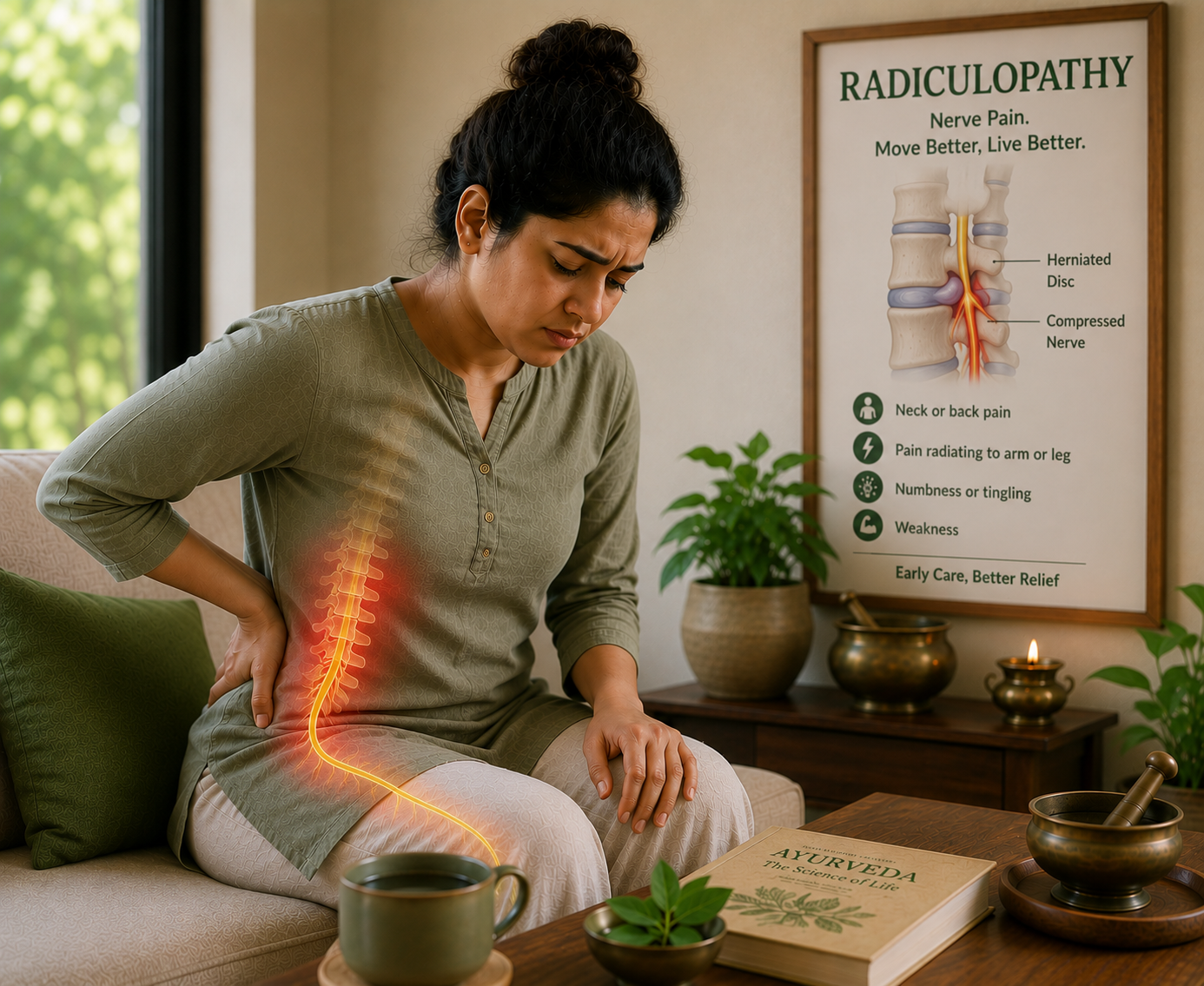
What is Radiculopathy Care in Ayurveda?
Radiculopathy care in Ayurveda represents the comprehensive classical Vata Vyadhi framework with specific sub-classifications including Gridhrasi (sciatica/lumbar radiculopathy) with substantial classical sophistication and Manyastambha (cervical radiculopathy) — addressing nerve compression syndromes through integrated specialised local therapies, comprehensive Vata-pacifying approach, gentle progressive integration, and sustained management. Scope encompasses: lumbar radiculopathy/sciatica (most common context, also see Sciatica page for detailed framework), cervical radiculopathy with arm symptoms (also see Cervical Spondylosis page), thoracic radiculopathy (less common), radiculopathy from disc herniation (also see IVDP, Slip Disc pages), radiculopathy from spinal stenosis, radiculopathy from foraminal narrowing, post-surgical radiculopathy recovery with substantial care, chronic recurrent radiculopathy seeking sustained management. Core frameworks: Kati Basti and Greeva Basti as cornerstone specialised local therapies matched to affected region, comprehensive Vata-pacifying internal formulations, gentle progressive integration essential with substantial care, comprehensive coordination with continued specialist care.
Understanding Gridhrasi, Manyastambha, and Vata Vyadhi Dynamics: The Ayurvedic Framework
The Ayurvedic understanding sits within comprehensive classical framework providing remarkably apt understanding of radicular pain syndromes. Gridhrasi (literally "vulture-like gait" referring to characteristic limping pattern in sciatica) represents dedicated classical framework specifically for sciatica with substantial sophistication, while Manyastambha addresses cervical radiculopathy patterns. Key concepts: substantial Vata aggravation as central given radicular pain primarily Vata Vyadhi presentation; comprehensive Vata Vyadhi affecting Snayuvaha and Majjavaha Srotas (ligament and nervous system channels); substantial Kapha-Vata combinations in obstructive patterns with structural compression; comprehensive Asthi-Majja Vyadhi dimensions in chronic cases; substantial classical recognition of Vata aggravation following specific nerve distribution paths with sophisticated framework remarkably anticipating modern neuroanatomy. Modern validation: substantial recent advances validating classical Vata Vyadhi framework's apt understanding of nerve compression syndromes.
The 3 Stages of Ayurvedic Treatment for Radiculopathy
Stage 1 — Preparation and Assessment (3-5 days): comprehensive radiculopathy history including specific symptom distribution and dermatomal pattern, severity, duration since onset, suspected underlying cause (disc herniation/stenosis/other), neurological symptoms including sensory and motor involvement, current neurological evaluation including MRI when available, current medications including pain management and any prescribed treatments, prior treatments and response, comprehensive Prakriti assessment, critical screening for warning signs warranting urgent specialist evaluation (progressive neurological deficit, bladder/bowel dysfunction indicating cauda equina syndrome which is medical emergency, severe weakness, suspected cervical myelopathy) — require urgent neurological/neurosurgical evaluation rather than retreat-based intervention, realistic expectations setting. Stage 2 — Core Treatment (14-21 days): comprehensive specialised local therapies matched to affected region (Kati Basti for lumbar, Greeva Basti for cervical), comprehensive Vata-pacifying internal formulations, comprehensive Abhyanga with substantial Vata-pacifying use, comprehensive Pinda Sweda variations matched to presentation, gentle progressive integration essential with substantial care avoiding aggressive maneuvers, comprehensive coordination with continued specialist care. Stage 3 — Sustained Neural Wellness (Continued): continued home Abhyanga essential, continued comprehensive gentle integration essential, continued physiotherapy when applicable, comprehensive sustained lifestyle integration with substantial postural and ergonomic focus.
The 5 Core Therapies for Radiculopathy Explained
1. Comprehensive Specialised Local Therapies — Kati Basti and Greeva Basti Matched to Affected Region: Kati Basti as cornerstone for lumbar radiculopathy/Gridhrasi with substantial classical sophistication providing comprehensive direct local Vata-pacifying effects through warm medicated oil retention over lumbar region; Greeva Basti as cornerstone for cervical radiculopathy/Manyastambha providing comprehensive direct local effects over cervical region; Prishtha Basti for thoracic radiculopathy when appropriate; standard preparations include Mahanarayana Taila, Sahacharadi Taila, Ksheerabala Taila particularly valuable for nervous system applications, specific Vata-pacifying oils matched to needs.
2. Comprehensive Vata-Pacifying Internal Formulations: Yogaraj Guggulu as cornerstone classical Vata Vyadhi formulation; Maharasnadi Kashayam with substantial classical use for Vata Vyadhi; Dashamoolarishtam for comprehensive Vata-pacifying support; Trayodashang Guggulu for substantial musculoskeletal-neurological support; Ashwagandha for substantial Mamsa Dhatu and nervous system support with adaptogenic benefits; Sahacharadi Kashayam for substantial Vata Vyadhi; Rasnasaptak Kashayam for chronic patterns; specific Vata-pacifying formulations matched to individual presentation.
3. Comprehensive Abhyanga and Pizhichil for Substantial Constitutional and Nervous System Support: daily comprehensive Abhyanga essential with substantial Vata-pacifying use providing comprehensive musculoskeletal and nervous system support; Pizhichil with substantial classical use for chronic Vata Vyadhi providing continuous warm medicated oil bathing with comprehensive Vata pacification, tissue nourishment, and substantial nervous system support particularly valuable for chronic radiculopathy patterns.
4. Comprehensive Pinda Sweda Variations for Substantial Musculoskeletal-Neurological Support: Patra Pinda Sweda (medicated leaf bolus fomentation) with substantial classical use for substantial Vata Vyadhi presentations; Shashtika Shali Pinda Sweda for substantial Dhatu nourishing particularly valuable in chronic depletion patterns providing comprehensive Mamsa-Asthi-Majja Dhatu support — Majja Dhatu support particularly relevant for nervous system dimensions characteristic of radiculopathy; specific Pinda Sweda matched to individual presentation with substantial care.
5. Gentle Progressive Integration with Comprehensive Postural Rehabilitation and Continued Specialist Coordination — Absolutely Essential: gentle progressive integration absolutely essential with substantial care — avoiding aggressive maneuvers that can worsen nerve compression, substantial care with manipulation which is generally contraindicated in radiculopathy with neurological involvement; comprehensive postural rehabilitation essential addressing underlying mechanical factors; comprehensive therapeutic Yoga integration with substantial care and qualified specialist guidance — specific care avoiding aggressive flexion in lumbar radiculopathy and aggressive cervical movements in cervical radiculopathy; comprehensive coordination with continued specialist care absolutely essential including continued neurological evaluation, continued physiotherapy when prescribed, continued pain management when applicable with substantial care regarding medication interactions, surgical consultation when clearly indicated.
How Long Should an Ayurvedic Radiculopathy Program Last?
| Duration | Therapeutic Benefit | |||
|
Initial specialised local therapy course, established foundation | |||
| 14–21 days | Comprehensive constitutional support with full integration | |||
| 21–28 days | Extended comprehensive program with substantial recovery foundation | |||
| Continued home regimen | Sustained gentle integration and continued specialist coordination essential |
The exact duration is decided after consultation with the Ayurvedic doctor based on specific radiculopathy context (cervical/lumbar/thoracic), severity, suspected underlying cause, duration since onset, neurological involvement, and individual factors. Substantial benefits typically develop over 3-6 weeks of comprehensive integrated approach with initial pain relief often noted within first 2 weeks. Critical recognition that radiculopathy with neurological involvement requires sustained specialist coordination — retreat-based programs provide substantial supportive value but sustained results require sustained comprehensive integration including continued home Abhyanga, continued comprehensive gentle integration, continued physiotherapy when applicable, continued specialist coordination essential. Warning signs including progressive neurological deficit, bladder/bowel dysfunction (cauda equina), severe weakness, suspected cervical myelopathy require urgent specialist care, never retreat-based intervention.
Book Consultation
Benefits of an Ayurvedic Treatment Retreat for Radiculopathy
| Physical Benefits | Functional Benefits | Long-Term Impact | ||||
|
Better daily functional capacity | Sustained neural wellness foundation | ||||
| Better neurological symptom support | Better sleep quality | Foundation for sustained recovery | ||||
| Better mobility | Better work productivity | Better long-term musculoskeletal-neurological outcomes | ||||
| Comprehensive Vata-pacifying support | Better mood and emotional balance | Comprehensive integrative framework |
Why Kerala is the Best Place for Radiculopathy Treatment
An Ayurvedic radiculopathy retreat in Kerala, India offers the most clinically authentic environment for comprehensive classical Gridhrasi, Manyastambha, and Vata Vyadhi Ayurveda alongside continued essential specialist care.
- Experienced physicians with specific expertise in classical Vata Vyadhi neurological-musculoskeletal Ayurveda
- BAMS and MD Ayurveda-certified doctors with specialised training in classical radiculopathy and chronic Vata Vyadhi management
- Specialised practitioner training in Kati Basti and Greeva Basti as cornerstone specialised local therapies
- Specialised practitioner training in comprehensive Vata-pacifying internal formulations
- Specialised practitioner training in comprehensive Abhyanga and Pizhichil for constitutional and nervous system support
- Specialised practitioner training in comprehensive Pinda Sweda variations including Patra Pinda Sweda and Shashtika Shali Pinda Sweda for Majja Dhatu support
- Specialised practitioner training in gentle progressive integration with substantial care essential for radiculopathy safety
- Specialised practitioner training in comprehensive therapeutic Yoga integration with substantial radiculopathy-specific expertise
- Specialised practitioner training in comprehensive postural rehabilitation
- Specialised practitioner training in comprehensive constitutional approach
- Specialised practitioner training in comprehensive lifestyle integration
- Substantial care principles throughout with absolute commitment to specialist coordination
- Authentic in-house preparation of cornerstone Vata-pacifying medicated oils — Mahanarayana Taila as foundational with substantial classical Vata-pacifying use, Sahacharadi Taila with substantial classical use for musculoskeletal-neurological conditions, Ksheerabala Taila particularly valuable for nervous system applications given substantial nervous system support, Dhanwantharam Taila for substantial constitutional support, Bala Taila for substantial constitutional support, Mahamasha Taila for substantial Vata Vyadhi with neurological dimensions, specific Vata-pacifying oils matched to individual needs
- Authentic in-house preparation of cornerstone Vata-pacifying internal formulations — Yogaraj Guggulu as cornerstone classical Vata Vyadhi formulation, Maharasnadi Kashayam with substantial classical use, Dashamoolarishtam for comprehensive Vata-pacifying support, Trayodashang Guggulu for substantial musculoskeletal-neurological support, Ashwagandha preparations for substantial Mamsa Dhatu and nervous system support, Sahacharadi Kashayam for substantial Vata Vyadhi, Rasnasaptak Kashayam for chronic patterns, Rasnadi Guggulu for chronic patterns, Vatari Guggulu for chronic Vata Vyadhi, Saraswatarishtam for substantial Medhya and nervous system support, specific Vata-pacifying formulations matched to individual presentation
- Authentic preparation of Pinda Sweda materials including Patra Pinda Sweda bolus materials, Shashtika Shali Pinda Sweda materials particularly valuable for Majja Dhatu nourishing
- Authentic preparation of comprehensive supportive herbs matched to individual presentation including specific nervous system-supportive herbs
- Capacity for comprehensive constitutional dietary preparation matched to individual Prakriti
- Capacity for qualified specialist Yoga instruction with experienced teachers specifically trained in radiculopathy applications including specific safe sequences with substantial care
- Capacity for comprehensive Pranayama instruction matched to current state
- Capacity for comprehensive meditation and mindfulness instruction
- Capacity for comprehensive postural assessment and rehabilitation guidance
- Capacity for comprehensive ergonomic education essential
- Capacity for therapeutic exercise integration with substantial care matched to neurological status
- Proper Kati Basti and Greeva Basti facilities with appropriate clinical infrastructure essential
- Proper specialised external therapy facilities for Pizhichil, Pinda Sweda, and broader therapies
- Calm Sattvic environment supporting recovery
- Substantial natural environment with comprehensive nature exposure benefits
- Capacity for emergency medical escalation with clear protocols absolutely essential for warning signs including progressive neurological deficit, bladder/bowel dysfunction (cauda equina syndrome — medical emergency)
- Absolute commitment to coordination with continued neurological and physiotherapy care
- Capacity for sustained long-term care relationships through chronic radiculopathy management
- Long-established Kerala tradition representing the deepest preservation of authentic classical Vata Vyadhi Ayurveda
- Discretion and sensitivity throughout treatment
Sri Lanka offers complementary tropical healing environment particularly valuable for sustained immersive radiculopathy programs, while Bali provides wellness-oriented treatment retreats integrating Ayurvedic care with holistic wellness particularly valuable for sustainable lifestyle integration. For specialised classical Gridhrasi and Manyastambha Vata Vyadhi Ayurveda with comprehensive Kati Basti and Greeva Basti capability, authentic Vata-pacifying formulation preparation, comprehensive Pinda Sweda capability including Shashtika Shali Pinda Sweda for Majja Dhatu support, and comprehensive gentle progressive integration capability with substantial care principles throughout, Kerala offers the deepest tradition globally.
Radiculopathy Treatment Retreats by Location and Recommended Centres
Kerala, India — The most clinically authentic destination globally for classical Gridhrasi, Manyastambha, and chronic Vata Vyadhi Ayurveda with the deepest preservation of authentic classical radiculopathy tradition including specialised comprehensive Kati Basti capability as cornerstone for lumbar radiculopathy/Gridhrasi with substantial classical sophistication — warm medicated oil retained over lumbar region using carefully constructed dough dam over 30-45 minutes providing comprehensive direct local Vata-pacifying effects with substantial benefits for sciatic nerve distribution as one of most clinically valuable specialised therapies for lumbar radiculopathy with substantial documented benefits, specialised comprehensive Greeva Basti capability as cornerstone for cervical radiculopathy/Manyastambha providing comprehensive direct local effects over cervical region with substantial classical sophistication particularly valuable for cervical nerve root involvement, specialised Prishtha Basti capability for thoracic radiculopathy when appropriate, using standard preparations including Mahanarayana Taila as foundational, Sahacharadi Taila particularly valuable for musculoskeletal-neurological conditions, Ksheerabala Taila particularly valuable for nervous system applications given substantial nervous system support, Dhanwantharam Taila for substantial constitutional support, Bala Taila, Mahamasha Taila for substantial Vata Vyadhi with neurological dimensions with substantial classical use specifically for chronic Vata Vyadhi affecting nervous system, specific Vata-pacifying oils matched to individual needs with 7-14 daily sessions providing substantial cumulative benefits, specialised comprehensive Vata-pacifying internal formulations with substantial classical sophistication including cornerstone formulations — Yogaraj Guggulu as cornerstone classical Vata Vyadhi formulation with substantial classical use specifically for chronic Vata Vyadhi neurological-musculoskeletal conditions, Maharasnadi Kashayam with substantial classical use, Dashamoolarishtam for comprehensive Vata-pacifying support, Trayodashang Guggulu for substantial musculoskeletal-neurological support, Ashwagandha for substantial Mamsa Dhatu and nervous system support with substantial documented evidence base, Sahacharadi Kashayam for substantial Vata Vyadhi, Rasnasaptak Kashayam for chronic patterns, Rasnadi Guggulu for chronic patterns, Vatari Guggulu for chronic Vata Vyadhi, Saraswatarishtam for substantial Medhya and nervous system support particularly valuable given Majja Dhatu involvement, specific Vata-pacifying formulations matched to individual presentation, specialised comprehensive Abhyanga and Pizhichil capability for substantial constitutional and nervous system support including daily comprehensive Abhyanga essential with substantial Vata-pacifying use providing comprehensive musculoskeletal and nervous system support and Pizhichil with substantial classical use for chronic Vata Vyadhi providing continuous warm medicated oil bathing with comprehensive Vata pacification, tissue nourishment, and substantial nervous system support particularly valuable for chronic radiculopathy patterns with substantial Dhatu Kshaya dimensions, specialised comprehensive Pinda Sweda variations capability for substantial musculoskeletal-neurological support including Patra Pinda Sweda (medicated leaf bolus fomentation) with substantial classical use for substantial Vata Vyadhi presentations, Shashtika Shali Pinda Sweda for substantial Dhatu nourishing particularly valuable in chronic depletion patterns providing comprehensive Mamsa-Asthi-Majja Dhatu support with substantial Majja Dhatu support particularly relevant for nervous system dimensions characteristic of radiculopathy as one of most clinically valuable specialised therapies for chronic radiculopathy with substantial Majja Kshaya, specific Pinda Sweda matched to individual presentation with substantial care, specialised gentle progressive integration capability with substantial care absolutely essential — avoiding aggressive maneuvers that can worsen nerve compression, substantial care with manipulation which is generally contraindicated in radiculopathy with neurological involvement as aggressive manipulation can worsen disc compromise and nerve compression, gentle progressive movement essential with qualified specialist guidance, specialised comprehensive postural rehabilitation capability essential addressing underlying mechanical factors contributing to radicular compression including comprehensive postural assessment and awareness training, specific postural correction exercises matched to affected region, sustained postural integration, specialised comprehensive therapeutic Yoga integration capability with substantial radiculopathy-specific expertise including specific safe sequences with substantial care and qualified specialist guidance, specific care avoiding aggressive flexion in lumbar radiculopathy which can worsen disc compromise, specific care avoiding aggressive cervical movements and inversions in cervical radiculopathy which are absolutely contraindicated given myelopathy risk, gentle therapeutic Yoga matched to neurological status, comprehensive meditation with substantial documented benefits for chronic pain, comprehensive ergonomic integration essential addressing modern lifestyle factors contributing to radicular compression including monitor at eye level for cervical-relevant ergonomics and appropriate chair support for lumbar-relevant ergonomics, comprehensive sustained physical activity integration matched to current state with substantial care, comprehensive constitutional dietary integration matched to predominance with substantial Vata-pacifying focus including warm grounding foods, adequate healthy fats including ghee, adequate quality protein for Mamsa-Majja Dhatu support, specific anti-inflammatory spices including turmeric with substantial documented anti-inflammatory benefits relevant to radiculopathy, comprehensive Dinacharya integration including consistent sleep schedule with appropriate sleep posture for radiculopathy contexts, comprehensive sleep hygiene, authentic in-house preparation of cornerstone Vata-pacifying medicated oils using authentic methods and sourcing standards, authentic in-house preparation of cornerstone Vata-pacifying internal formulations, authentic preparation of Pinda Sweda materials including specialised bolus preparations particularly Shashtika Shali Pinda Sweda for Majja Dhatu nourishing, authentic preparation of comprehensive supportive herbs matched to individual presentation including specific nervous system-supportive herbs, capacity for comprehensive constitutional dietary preparation matched to individual Prakriti, capacity for qualified specialist Yoga instruction essential with experienced teachers specifically trained in radiculopathy applications including specific safe sequences with substantial care, capacity for comprehensive Pranayama instruction matched to current state, capacity for comprehensive meditation and mindfulness instruction with substantial evidence base for chronic pain, capacity for comprehensive postural assessment and rehabilitation guidance essential, capacity for comprehensive ergonomic education essential, capacity for therapeutic exercise integration with substantial care matched to neurological status, proper Kati Basti and Greeva Basti facilities with appropriate clinical infrastructure essential, proper specialised external therapy facilities for Pizhichil and Pinda Sweda and broader therapies, calm Sattvic environment supporting recovery, substantial natural environment with comprehensive nature exposure benefits, capacity for emergency medical escalation when relevant for warning signs absolutely essential — including progressive neurological deficit (requires urgent neurological evaluation), bladder or bowel dysfunction which indicates cauda equina syndrome — medical emergency requiring immediate evaluation and typically surgical intervention, severe weakness (requires urgent evaluation), suspected cervical myelopathy (medical emergency), substantial worsening of neurological symptoms — never delayed for retreat-based intervention, absolute commitment to coordination with continued neurological and physiotherapy care as Ayurvedic care complements rather than replaces continued specialist care which is essential for radiculopathy management, integration with continued evidence-based interventions including continued physiotherapy when prescribed and continued pain management when applicable with substantial care regarding medication interactions, surgical consultation when clearly indicated for substantial structural causes with progressive neurological deficit, continued mental health care when relevant given substantial chronic pain-mental health connection, capacity for sustained long-term care relationships through chronic radiculopathy management, substantial care principles throughout with absolute commitment to specialist coordination, and the deepest preservation of authentic classical Vata Vyadhi Ayurveda globally. Alleppey • Kovalam • Kumarakom • Wayanad • Palakkad
Sri Lanka — Coastal Ayurveda treatment retreats with comprehensive classical Gridhrasi and Manyastambha Ayurveda in serene tropical environment particularly valuable for sustained immersive radiculopathy programs and comprehensive constitutional rebuilding. Wadduwa • Weligama • Sigiriya • Kosgoda • Bentota
Bali, Indonesia — Wellness treatment retreats integrating Ayurvedic care with holistic wellness, particularly valuable for sustainable lifestyle integration for chronic radiculopathy management. Ubud • Nusa Dua • Candidasa • Lovina
WellnessLoka connects you with verified centres offering genuine classical Gridhrasi, Manyastambha, and Vata Vyadhi Ayurvedic expertise, comprehensive Kati Basti and Greeva Basti capability essential matched to affected region, comprehensive Pinda Sweda capability including Shashtika Shali Pinda Sweda for Majja Dhatu support, authentic classical Vata-pacifying formulation preparation, comprehensive Abhyanga and Pizhichil capability, capacity for gentle progressive integration with substantial care essential, capacity for comprehensive therapeutic Yoga integration with substantial radiculopathy-specific expertise essential, capacity for emergency medical escalation absolutely essential for warning signs including cauda equina syndrome, absolute commitment to coordination with continued neurological and physiotherapy care, substantial care principles throughout, and clear understanding of integrative role.
Who Should Consider an Ayurvedic Radiculopathy Treatment Retreat
Critical foundation: Ayurvedic care is strictly supportive integrative role alongside continued essential specialist care — never replacement for continued neurological evaluation and continued essential treatments, and warning signs including progressive neurological deficit and bladder/bowel dysfunction (cauda equina) require urgent specialist care. Patients with chronic lumbar radiculopathy/sciatica on continued specialist care (most common context, also see Sciatica page) — Comprehensive Kati Basti-led approach with Vata-pacifying integration. Patients with chronic cervical radiculopathy with arm symptoms on continued care (also see Cervical Spondylosis page) — Comprehensive Greeva Basti-led approach with substantial care. Patients with stable radiculopathy from disc herniation on continued care (also see IVDP, Slip Disc pages) — Comprehensive integrative approach with substantial care. Patients with radiculopathy from spinal stenosis on continued care — Comprehensive integrative approach. Patients with post-surgical radiculopathy recovery with surgical clearance and substantial care. Patients with chronic recurrent radiculopathy seeking sustained management approach. Patients seeking comprehensive integration with continued physiotherapy for synergistic benefits.
Who Should Approach Treatment with Caution
Ayurvedic care for radiculopathy requires substantial care given neurological involvement. Retreat-based care should be deferred or replaced by urgent specialist care for: progressive neurological deficit including progressive weakness or sensory loss — requires urgent neurological evaluation; bladder or bowel dysfunction — cauda equina syndrome is medical emergency requiring immediate evaluation and typically surgical intervention; severe weakness with substantial functional impact — requires urgent evaluation; suspected cervical myelopathy with substantial signs (gait disturbance, hand clumsiness, hyperreflexia) — medical emergency requiring urgent neurosurgical evaluation; acute severe radicular pain without prior evaluation — requires evaluation; suspected new disc herniation with substantial neurological involvement — requires urgent evaluation; substantial recent trauma — requires evaluation; patients planning to discontinue prescribed treatments without specialist guidance; patients with unrealistic expectations including Ayurvedic cure of structural pathologies — honest framing essential. Centres claiming Ayurvedic cure of severe radiculopathy or use of aggressive manipulation should be absolutely avoided given substantial risk of worsening nerve compression.
Choosing the Right Treatment Retreat for Radiculopathy
Qualified physicians with Vata Vyadhi neurological-musculoskeletal Ayurveda expertise — BAMS or MD Ayurveda-credentialed doctors with specialised training. Specialised practitioner training in Kati Basti and Greeva Basti as cornerstone specialised local therapies matched to affected region, comprehensive Vata-pacifying internal formulations, comprehensive Abhyanga and Pizhichil for nervous system support, comprehensive Pinda Sweda variations including Shashtika Shali Pinda Sweda for Majja Dhatu support, gentle progressive integration with substantial care essential, comprehensive therapeutic Yoga integration with substantial radiculopathy-specific expertise, comprehensive postural rehabilitation, comprehensive constitutional approach, comprehensive lifestyle integration. Authentic in-house preparation of cornerstone Vata-pacifying medicated oils including Mahanarayana Taila and Sahacharadi Taila and Ksheerabala Taila and Mahamasha Taila, Vata-pacifying internal formulations including Yogaraj Guggulu and Maharasnadi Kashayam and Saraswatarishtam, Pinda Sweda materials. Capacity for qualified specialist Yoga instruction with radiculopathy-specific expertise essential. Proper specialised facilities including Kati Basti and Greeva Basti infrastructure essential. Capacity for emergency medical escalation for warning signs absolutely essential. Absolute commitment to coordination with continued neurological and physiotherapy care — essential and non-negotiable. Substantial care principles throughout with absolute avoidance of aggressive manipulation.
How WellnessLoka Helps You Choose the Right Ayurveda Treatment Retreat for Radiculopathy
Choosing the right treatment retreat for radiculopathy benefits enormously from genuine guidance with substantial sensitivity to neurological involvement considerations and absolute commitment to substantial care principles throughout. Radiculopathy spans broad spectrum with substantial individual variation in affected region (cervical, lumbar, thoracic), severity, underlying cause (disc herniation, spinal stenosis, foraminal narrowing, spondylolisthesis, other), neurological involvement, comorbidities, and constitutional context — and given fundamental requirement for sustained specialist coordination with substantial care principles essential, comprehensive integrative framework with substantial care is paramount. Critical importance of authentic classical Vata Vyadhi care with substantial care principles and absolute specialist coordination: substantial variation in centre quality requires careful selection; recognition that authentic radiculopathy Ayurveda requires substantial classical expertise across Kati Basti and Greeva Basti as cornerstone specialised local therapies matched to affected region with substantial classical sophistication, comprehensive Vata-pacifying internal formulations, comprehensive Abhyanga and Pizhichil with substantial nervous system support, comprehensive Pinda Sweda variations including Shashtika Shali Pinda Sweda for Majja Dhatu support, gentle progressive integration with substantial care absolutely essential avoiding aggressive manipulation that can worsen nerve compression, comprehensive therapeutic Yoga integration with substantial radiculopathy-specific expertise and qualified specialist guidance, comprehensive postural rehabilitation, comprehensive constitutional approach, and substantial care principles throughout with absolute commitment to specialist coordination including continued neurological evaluation and continued physiotherapy when applicable. The right program depends on accurate assessment with appropriate red flag screening including progressive neurological deficit and cauda equina syndrome features, appropriate intervention selection matched to specific radiculopathy presentation and affected region with substantial care, comprehensive specialised local therapy matched to affected region (Kati Basti for lumbar, Greeva Basti for cervical), comprehensive Vata-pacifying internal formulations matched to constitution, comprehensive Pinda Sweda matched to presentation, gentle progressive integration with substantial care absolutely essential, comprehensive therapeutic Yoga integration with substantial care and qualified specialist guidance, comprehensive postural rehabilitation, absolute coordination with continued specialist care including continued neurological evaluation and continued physiotherapy when applicable and continued pain management when applicable, and sustained integration commitment which is fundamental for sustainable radiculopathy management. WellnessLoka exists to ensure that radiculopathy patients can make this decision with full information, genuine guidance, realistic expectations, complete clinical safety awareness regarding warning signs requiring urgent specialist care, and substantial care principles throughout.
Access to Verified Retreat Centres Every centre listed on WellnessLoka for radiculopathy has been independently assessed for physician credentials, specific expertise in classical Vata Vyadhi neurological-musculoskeletal Ayurveda with substantial care principles with substantial classical literature providing remarkably apt framework for radicular pain syndromes including substantial classical recognition of Gridhrasi (literally "vulture-like gait" referring to characteristic limping pattern in sciatica) as dedicated classical framework specifically for sciatica with substantial sophistication remarkably anticipating modern neuroanatomy of sciatic nerve distribution, Manyastambha addressing cervical radiculopathy patterns, substantial Vata aggravation as central given radicular pain primarily Vata Vyadhi presentation, comprehensive Vata Vyadhi affecting Snayuvaha and Majjavaha Srotas (ligament and nervous system channels), substantial Kapha-Vata combinations in obstructive patterns with structural compression, comprehensive Asthi-Majja Vyadhi dimensions in chronic cases, substantial classical recognition of Vata aggravation following specific nerve distribution paths with sophisticated framework, depth of expertise in comprehensive specialised local therapies — Kati Basti and Greeva Basti matched to affected region with substantial classical sophistication, Kati Basti as cornerstone for lumbar radiculopathy/Gridhrasi providing comprehensive direct local Vata-pacifying effects with substantial benefits for sciatic nerve distribution through warm medicated oil retention over lumbar region using carefully constructed dough dam over 30-45 minutes as one of most clinically valuable specialised therapies for lumbar radiculopathy with substantial documented benefits, Greeva Basti as cornerstone for cervical radiculopathy/Manyastambha providing comprehensive direct local effects over cervical region with substantial classical sophistication particularly valuable for cervical nerve root involvement, Prishtha Basti for thoracic radiculopathy when appropriate, using standard preparations (Mahanarayana Taila as foundational with substantial classical Vata-pacifying use, Sahacharadi Taila particularly valuable for musculoskeletal-neurological conditions, Ksheerabala Taila particularly valuable for nervous system applications, Dhanwantharam Taila, Bala Taila, Mahamasha Taila for substantial Vata Vyadhi with neurological dimensions with substantial classical use specifically for chronic Vata Vyadhi affecting nervous system, specific Vata-pacifying oils matched to individual needs), with 7-14 daily sessions providing substantial cumulative benefits, specialised comprehensive Vata-pacifying internal formulations with substantial classical sophistication including cornerstone formulations (Yogaraj Guggulu as cornerstone classical Vata Vyadhi formulation with substantial classical use specifically for chronic Vata Vyadhi neurological-musculoskeletal conditions, Maharasnadi Kashayam, Dashamoolarishtam, Trayodashang Guggulu for substantial musculoskeletal-neurological support, Ashwagandha for substantial Mamsa Dhatu and nervous system support with substantial documented evidence base on stress modulation and nervous system support, Sahacharadi Kashayam, Rasnasaptak Kashayam, Rasnadi Guggulu, Vatari Guggulu for chronic Vata Vyadhi, Saraswatarishtam for substantial Medhya and nervous system support particularly valuable given Majja Dhatu involvement in radiculopathy, specific Vata-pacifying formulations matched to individual presentation), specialised comprehensive Abhyanga and Pizhichil capability for substantial constitutional and nervous system support, specialised comprehensive Pinda Sweda variations capability including Patra Pinda Sweda (medicated leaf bolus fomentation) with substantial classical use, Shashtika Shali Pinda Sweda for substantial Dhatu nourishing particularly valuable in chronic depletion patterns providing comprehensive Mamsa-Asthi-Majja Dhatu support with substantial Majja Dhatu support particularly relevant for nervous system dimensions characteristic of radiculopathy as one of most clinically valuable specialised therapies for chronic radiculopathy with substantial Majja Kshaya, specific Pinda Sweda matched to individual presentation, specialised gentle progressive integration capability with substantial care absolutely essential — avoiding aggressive maneuvers that can worsen nerve compression, substantial care with manipulation which is generally contraindicated in radiculopathy with neurological involvement as aggressive manipulation can worsen disc compromise and nerve compression substantially, gentle progressive movement essential with qualified specialist guidance, specialised comprehensive postural rehabilitation capability essential addressing underlying mechanical factors contributing to radicular compression, specialised comprehensive therapeutic Yoga integration capability with substantial radiculopathy-specific expertise including specific safe sequences with substantial care and qualified specialist guidance, specific care avoiding aggressive flexion in lumbar radiculopathy which can worsen disc compromise, specific care avoiding aggressive cervical movements and inversions in cervical radiculopathy which are absolutely contraindicated given myelopathy risk, gentle therapeutic Yoga matched to neurological status with substantial care, comprehensive meditation with substantial documented benefits for chronic pain, comprehensive ergonomic integration essential addressing modern lifestyle factors contributing to radicular compression, comprehensive constitutional dietary integration matched to predominance with substantial Vata-pacifying focus including warm grounding foods and adequate healthy fats including ghee and adequate quality protein for Mamsa-Majja Dhatu support and specific anti-inflammatory spices including turmeric with substantial documented anti-inflammatory benefits, comprehensive Dinacharya integration including consistent sleep schedule with appropriate sleep posture, authentic in-house preparation of cornerstone Vata-pacifying medicated oils essential using authentic methods, authentic in-house preparation of cornerstone Vata-pacifying internal formulations essential including Mahamasha Taila and Saraswatarishtam for nervous system support, authentic preparation of Pinda Sweda materials including specialised bolus preparations particularly Shashtika Shali Pinda Sweda for Majja Dhatu nourishing, authentic preparation of comprehensive supportive herbs matched to individual presentation including specific nervous system-supportive herbs, capacity for comprehensive constitutional dietary preparation matched to individual Prakriti, capacity for qualified specialist Yoga instruction essential with experienced teachers specifically trained in radiculopathy applications including specific safe sequences with substantial care, capacity for comprehensive Pranayama instruction matched to current state, capacity for comprehensive meditation and mindfulness instruction with substantial evidence base for chronic pain, capacity for comprehensive postural assessment and rehabilitation guidance essential, capacity for comprehensive ergonomic education essential, capacity for therapeutic exercise integration with substantial care matched to neurological status, proper Kati Basti and Greeva Basti facilities with appropriate clinical infrastructure essential, proper specialised external therapy facilities for Pizhichil and Pinda Sweda and broader therapies, calm Sattvic environment supporting recovery, substantial natural environment, capacity for emergency medical escalation with clear protocols absolutely essential for warning signs including progressive neurological deficit (requires urgent neurological evaluation), bladder or bowel dysfunction which indicates cauda equina syndrome — medical emergency requiring immediate evaluation and typically surgical intervention, severe weakness, suspected cervical myelopathy (medical emergency), substantial worsening of neurological symptoms — never delayed for retreat-based intervention, absolute commitment to coordination with continued neurological and physiotherapy care as Ayurvedic care complements rather than replaces continued specialist care which is essential for radiculopathy management, integration with continued evidence-based interventions including continued physiotherapy when prescribed and continued pain management when applicable with substantial care regarding medication interactions, surgical consultation when clearly indicated for substantial structural causes with progressive neurological deficit, continued mental health care when relevant given substantial chronic pain-mental health connection, capacity for sustained long-term care relationships through chronic radiculopathy management, substantial care principles throughout with absolute commitment to specialist coordination, and clear understanding of integrative role recognising that radiculopathy with neurological involvement requires sustained specialist coordination with integrative Ayurvedic care providing meaningful supportive value alongside continued essential specialist care, not replacement for evidence-based radiculopathy management — substantial pain relief, better neurological symptom support, better mobility, comprehensive Vata-pacifying support, and quality of life enhancement often achievable with sustained integrated approach combining continued specialist care with comprehensive lifestyle integration. We list only centres where authentic Vata Vyadhi Ayurveda is genuinely practised with classical depth and absolute commitment to substantial care principles and specialist coordination — centres claiming Ayurvedic cure of severe radiculopathy or use of aggressive manipulation are absolutely avoided as dangerous.
Free Pre-Retreat Consultation with Our Ayurvedic Doctor Before you choose a retreat, WellnessLoka offers a complimentary consultation with our in-house Ayurvedic consultant. This consultation reviews your specific radiculopathy context (specific symptom distribution and dermatomal pattern including cervical/lumbar/thoracic, severity, duration since onset, suspected underlying cause including disc herniation/stenosis/other, neurological symptoms including sensory and motor involvement, current neurological evaluation including MRI when available, current medications including pain management and any prescribed treatments, prior treatments and response including physiotherapy and epidural injections, comorbidities, lifestyle factors with substantial attention to postural and ergonomic factors) and comprehensive Prakriti (constitutional) assessment through classical frameworks. A critical part of this consultation is screening for warning signs warranting urgent specialist evaluation — particularly important in radiculopathy context — including progressive neurological deficit (requires urgent neurological evaluation), bladder or bowel dysfunction indicating cauda equina syndrome which is medical emergency requiring immediate evaluation, severe weakness with substantial functional impact, suspected cervical myelopathy with substantial signs (medical emergency), acute severe radicular pain without prior evaluation, suspected new disc herniation with substantial neurological involvement, substantial recent trauma — that require urgent specialist care rather than retreat-based intervention. Realistic expectations setting: comprehensive discussion of realistic expectations regarding radiculopathy integrative supportive role, fundamental requirement for continued specialist coordination including continued neurological evaluation and continued physiotherapy when applicable, sustained integration requirements particularly gentle progressive integration with substantial care and comprehensive postural rehabilitation essential, recognition that integrative approach complements continued specialist care, substantial care principles essential throughout with absolute avoidance of aggressive manipulation. Based on the assessment, we match you with the retreat centre and program duration best suited for your specific radiculopathy context. It is purely a guidance consultation.
Transparent Centre Comparison WellnessLoka provides clear, honest information about each listed centre — physician qualifications, Kati Basti and Greeva Basti capability essential matched to affected region, comprehensive Pinda Sweda capability including Shashtika Shali Pinda Sweda for Majja Dhatu support, authentic classical Vata-pacifying formulation preparation capability, comprehensive Abhyanga and Pizhichil capability, gentle progressive integration capability with substantial care, comprehensive therapeutic Yoga integration capability with substantial radiculopathy-specific expertise, comprehensive postural rehabilitation capability, ergonomic education capability, environment quality, accommodation features, program structure, and pricing — allowing comparison across Kerala, Sri Lanka, and Bali with full clarity.
Best Price Guarantee Through our strong, long-standing relationships with partner centres, you benefit from exclusive partner pricing that is always lower than booking directly. You receive the most authentic care without paying more for it.
Retreats for Every Budget From luxury wellness resorts to affordable, authentic healing centres, WellnessLoka helps you find a radiculopathy retreat that aligns perfectly with your comfort level and budget — without ever compromising on the authentic classical expertise and substantial care principles this care fundamentally benefits from.
Treatment is in Expert Hands Once you arrive at your chosen retreat, your radiculopathy program is fully designed and managed by the qualified Ayurvedic physicians at that centre with deep training in classical Gridhrasi, Manyastambha, and Vata Vyadhi neurological-musculoskeletal Ayurveda and direct, hands-on familiarity with Kati Basti and Greeva Basti as cornerstone specialised local therapies matched to affected region, comprehensive Vata-pacifying internal formulations including Yogaraj Guggulu and Maharasnadi Kashayam and Saraswatarishtam, comprehensive Abhyanga and Pizhichil for nervous system support, comprehensive Pinda Sweda variations including Shashtika Shali Pinda Sweda for Majja Dhatu support, gentle progressive integration with substantial care essential, comprehensive therapeutic Yoga integration with substantial radiculopathy-specific expertise and qualified specialist guidance, comprehensive postural rehabilitation, comprehensive constitutional approach, substantial care principles throughout including absolute avoidance of aggressive manipulation, and broader classical Vata Vyadhi therapies your program involves. Treatment unfolds under continuous qualified supervision with unwavering coordination with your continued neurological and physiotherapy care.
Local Support Team Our on-ground experts assist you at every step from first enquiry through retreat completion — with appropriate sensitivity to radiculopathy-related functional considerations including pain management and accommodation considerations.
End-to-End Booking Support Full administrative and logistical support — ensuring smooth process so you focus entirely on preparing for your transformative healing program.
Why Travellers Trust WellnessLoka WellnessLoka is rated 4.9? on Google, with verified reviews from wellness travellers from 28+ countries, backed by over a decade of expertise. Our dedicated support team is available 24×7.
Begin Your Healing Journey
Radiculopathy represents one of the most clinically significant neurological pain syndromes globally with substantial impact on daily activities, work productivity, sleep, and quality of life through characteristic radiating pain along specific nerve distributions. Modern medicine has substantially advanced with comprehensive evidence-based framework including comprehensive neurological specialist care, comprehensive imaging when indicated, comprehensive physiotherapy as foundational intervention, comprehensive pain management when applicable, epidural injections when indicated, surgical intervention when clearly indicated for substantial structural causes with progressive neurological deficit. Classical Ayurvedic care offers meaningful integrative contributions through the comprehensive Gridhrasi, Manyastambha, and Vata Vyadhi framework including Kati Basti and Greeva Basti as cornerstone specialised local therapies matched to affected region, comprehensive Vata-pacifying internal formulations, comprehensive Abhyanga and Pizhichil with substantial nervous system support, comprehensive Pinda Sweda variations including Shashtika Shali Pinda Sweda for Majja Dhatu support, gentle progressive integration with substantial care absolutely essential, comprehensive therapeutic Yoga integration with substantial radiculopathy-specific expertise. Continued specialist coordination essential — never replace continued neurological evaluation. Warning signs including cauda equina syndrome require urgent specialist care. Whether in Kerala, Sri Lanka, or Bali, Ayurvedic care offers thoughtful integrative path to comprehensive neural wellness alongside continued evidence-based specialist care.


