

When the Thyroid Overworks: An Ayurvedic Path to Symptom Relief and Constitutional Balance
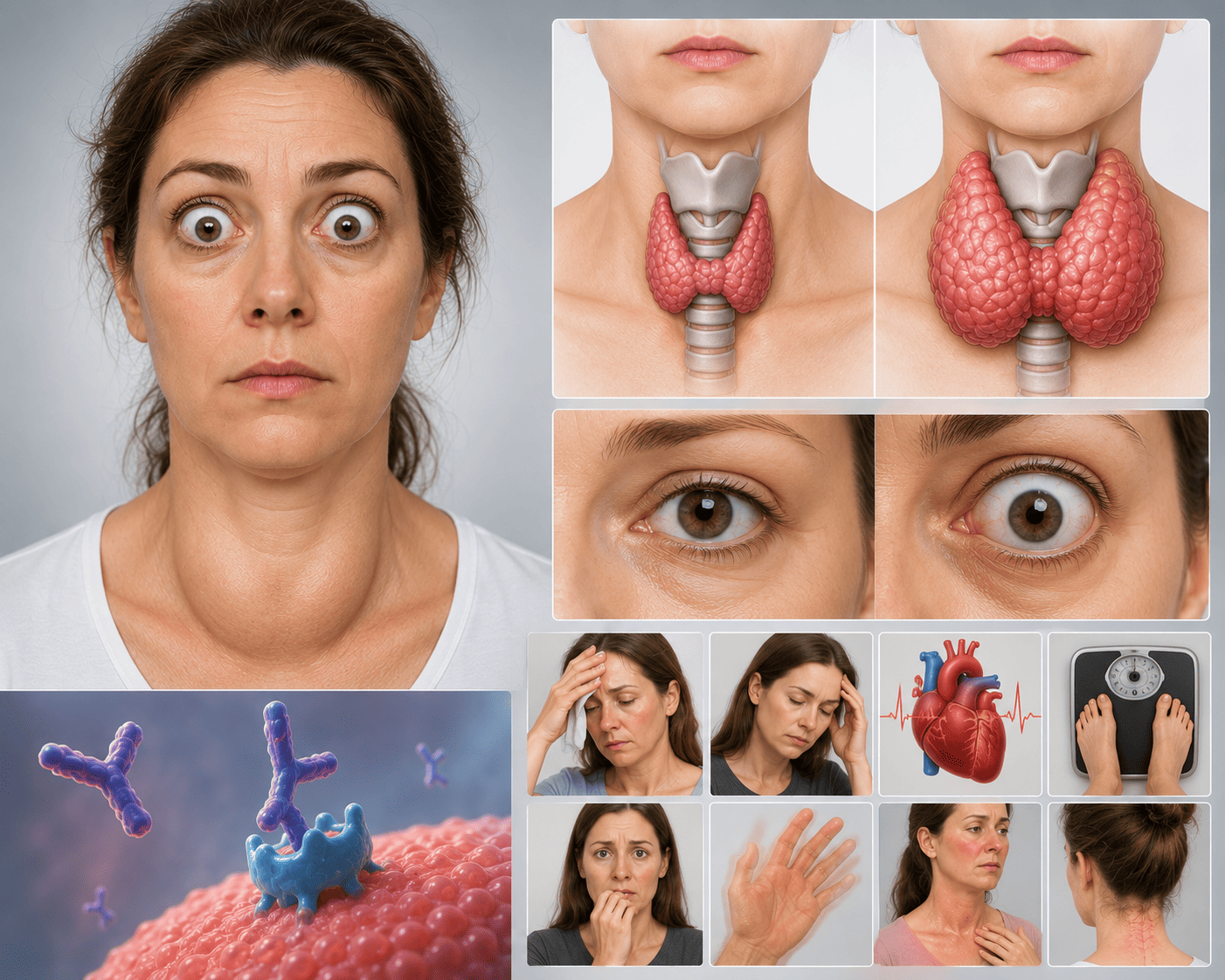
Graves' Disease represents the most common cause of hyperthyroidism, affecting an estimated 0.5-2% of the population with substantial gender disparity (women 7-10 times more affected than men), peak incidence in ages 30-50, and significant impact on quality of life through systemic symptoms, psychological dimensions, ophthalmic complications, and broader constitutional effects. The condition is an autoimmune disorder where thyroid-stimulating immunoglobulins (TSI) bind to TSH receptors on thyroid follicular cells producing sustained inappropriate thyroid stimulation, hormone overproduction, and the characteristic clinical syndrome of hyperthyroidism with the additional autoimmune complications particularly affecting the eyes (Graves' ophthalmopathy/orbitopathy) and rarely the skin (pretibial myxedema).
The clinical presentation involves a constellation of hyperthyroid symptoms reflecting the systemic effects of thyroid hormone excess. Cardiovascular: palpitations, tachycardia, atrial fibrillation (particularly in older patients), high-output cardiac state, occasionally cardiomyopathy. Metabolic: unintentional weight loss despite increased appetite, heat intolerance, excessive sweating, increased metabolic rate. Neuropsychiatric: anxiety, irritability, restlessness, insomnia, tremor (typically fine hand tremor), emotional lability, sometimes frank psychiatric manifestations. Gastrointestinal: increased frequency of bowel movements, sometimes frank diarrhea. Reproductive: menstrual irregularities in women, reduced fertility, occasionally erectile dysfunction in men. Musculoskeletal: proximal muscle weakness, fatigue despite hyperactivity, accelerated bone loss with osteoporosis risk. Dermatological: warm moist skin, hair thinning, nail changes.
Graves'-specific features distinguishing from other hyperthyroid causes:
- Graves' ophthalmopathy affecting 25-50% of patients — eye protrusion (exophthalmos/proptosis), lid retraction, periorbital edema, conjunctival injection, double vision (diplopia), in severe cases vision-threatening complications
- Diffuse goiter — Symmetric thyroid enlargement
- Pretibial myxedema — Rare skin manifestation
- Thyroid acropachy — Rare nail/digit changes
Modern medical management involves three established treatment approaches with substantial evidence base. Antithyroid medications (methimazole/carbimazole as first-line, propylthiouracil for specific situations) blocking thyroid hormone synthesis — typically continued 12-18 months with remission rates of 30-50%, requires monitoring for side effects particularly agranulocytosis and hepatotoxicity. Radioactive iodine (RAI) therapy providing definitive treatment by destroying thyroid tissue — typically produces hypothyroidism requiring lifelong levothyroxine replacement, contraindicated in pregnancy, may worsen ophthalmopathy in some cases. Thyroidectomy (surgical removal) — definitive treatment producing hypothyroidism requiring lifelong replacement, indicated for large goiter, ophthalmopathy concerns, pregnancy, or patient preference. Beta-blockers for symptomatic relief of cardiovascular and tremor symptoms while definitive treatment is established. Graves' ophthalmopathy management including local measures, corticosteroids, immunosuppressants, orbital radiation, decompression surgery for severe cases, with newer biologic agents (teprotumumab) for active moderate-to-severe disease.
While conventional treatment provides effective approaches for managing hyperthyroidism, substantial therapeutic gaps and complementary roles exist where Ayurveda offers genuine value:
Patients with mild Graves' disease seeking comprehensive integrative approach — Those with mild hyperthyroidism considering antithyroid medications seeking complementary supportive approach.
Patients on antithyroid medications seeking integrative support — Comprehensive approach for symptom management, side effect mitigation, and supporting potential remission.
Patients in remission seeking sustained constitutional support — Recognising relapse risk and value of comprehensive integrative approach for sustained wellbeing.
Post-RAI or post-thyroidectomy patients — Those who have undergone definitive treatment seeking comprehensive recovery support and constitutional rebuilding.
Patients with persistent symptoms despite treatment — Anxiety, fatigue, weight issues, sleep problems persisting after biochemical control.
Patients with substantial anxiety and stress dimensions — Comprehensive Pitta-Vata pacification addressing the substantial neuropsychiatric components.
Patients with mild Graves' ophthalmopathy — Supportive integrative care alongside continued ophthalmology coordination.
Patients seeking constitutional approach — Comprehensive Ayurvedic framework for autoimmune and endocrine health.
Patients with associated reproductive issues — Menstrual irregularities, fertility concerns benefiting from comprehensive approach.
Classical Ayurveda addresses Graves' Disease patterns within the framework of Galaganda (thyroid disorders), Atyagni (excessive digestive fire — corresponding remarkably to hypermetabolic state), and Bhasmaka (excessive metabolism producing tissue depletion) with substantial Pitta-Vata vitiation and Rasa-Rakta-Mamsa Dhatu involvement. The classical understanding provides comprehensive supportive framework. The therapeutic approach includes comprehensive Pitta-Vata pacifying therapy; Galaganda-specific herbs particularly Kanchanara Guggulu with substantial classical use for thyroid conditions; Brahmi-led adaptogens for nervous system support; Shirodhara for substantial anxiety and stress dimensions; Shatavari and Ashwagandha (used cautiously in active hyperthyroidism) for constitutional support; comprehensive lifestyle integration including stress management; coordination with continued endocrinology care essential for biochemical monitoring and conventional treatments.
A Graves' Disease treatment retreat is best understood as comprehensive supportive integrative care complementing continued endocrinology management — providing symptom management, stress reduction, constitutional support, and quality of life enhancement. WellnessLoka centres provide honest framing: Ayurveda does not replace antithyroid medications, RAI, or thyroidectomy for active Graves' disease but provides meaningful supportive role alongside these treatments.
What is Graves' Disease?
Graves' Disease is an autoimmune disorder where thyroid-stimulating immunoglobulins (TSI) bind to TSH receptors producing sustained inappropriate thyroid stimulation, hormone overproduction, and characteristic hyperthyroidism syndrome with autoimmune ophthalmopathy and rare dermatological manifestations.
Definition and characteristics:
- Autoimmune hyperthyroidism (most common cause of hyperthyroidism)
- TSI antibodies stimulating TSH receptors
- Diffuse goiter typically present
- Often associated with Graves' ophthalmopathy
- Substantial gender disparity (women 7-10x more affected)
- Peak incidence ages 30-50
- Family history of autoimmune disease common
Pathophysiology:
- Autoimmune production of TSI (thyroid-stimulating immunoglobulin)
- TSI binds TSH receptors causing sustained thyroid stimulation
- Excessive thyroid hormone production (T3, T4)
- Suppressed TSH from negative feedback
- Diffuse goiter from chronic stimulation
- Ophthalmopathy from autoimmune attack on retro-orbital tissues
- Genetic predisposition (HLA associations, multiple genes)
- Environmental triggers (stress, infection, smoking, iodine excess, postpartum)
Common symptoms:
Cardiovascular: palpitations, tachycardia, atrial fibrillation, high-output state Metabolic: weight loss despite increased appetite, heat intolerance, excessive sweating Neuropsychiatric: anxiety, irritability, insomnia, tremor, emotional lability Gastrointestinal: frequent bowel movements, diarrhea Reproductive: menstrual irregularities, reduced fertility Musculoskeletal: proximal muscle weakness, fatigue, bone loss Dermatological: warm moist skin, hair thinning
Graves'-specific features:
- Graves' ophthalmopathy (25-50%)
- Diffuse goiter
- Pretibial myxedema (rare)
- Thyroid acropachy (rare)
Risk factors:
- Female sex (substantial predominance)
- Family history of autoimmune disease
- Other autoimmune conditions
- Smoking (substantial risk factor particularly for ophthalmopathy)
- Stress
- Pregnancy/postpartum
- Iodine excess
- Specific medications (amiodarone, interferon)
- Specific genetic factors
Diagnosis:
- Clinical assessment of hyperthyroid features
- TSH suppressed, T3 and T4 elevated
- TSI/TRAb antibodies positive (diagnostic of Graves')
- Thyroid ultrasound showing diffuse enlargement with increased vascularity
- Radioactive iodine uptake elevated and diffuse (when indicated)
- Eye examination for ophthalmopathy
- Other autoimmune screening as appropriate
Modern medical management:
- Antithyroid medications (methimazole, propylthiouracil) — first-line for many
- Radioactive iodine (RAI) — definitive treatment
- Thyroidectomy — definitive surgical treatment
- Beta-blockers — symptomatic relief
- Graves' ophthalmopathy management — local measures, corticosteroids, immunosuppressants, teprotumumab, orbital decompression
- Lifelong monitoring essential
Understanding Galaganda and Atyagni: The Ayurvedic Root of Graves' Disease
The Ayurvedic understanding of Graves' Disease sits within the framework of Galaganda (thyroid disorders), Atyagni (excessive digestive fire), and Bhasmaka (excessive metabolism producing tissue depletion) with substantial Pitta-Vata vitiation and Rasa-Rakta-Mamsa Dhatu involvement.
Core concepts:
Galaganda Framework — Classical category of thyroid/neck swelling conditions:
- Various types based on doshic predominance
- Comprehensive therapeutic framework
- Direct anatomical correspondence to thyroid
Atyagni — Excessive digestive fire:
- Corresponds remarkably to hypermetabolic state of hyperthyroidism
- Excessive food intake with weight loss
- Heat patterns
- Substantial Pitta predominance
Bhasmaka — Pathological excessive metabolism:
- Characterized by excessive hunger, weight loss despite eating, tissue depletion
- Corresponds to advanced hypermetabolic hyperthyroidism
- Tissue (Dhatu) depletion central feature
Pitta-Vata Combined Pathology:
- Pitta predominance: Heat intolerance, sweating, hypermetabolism, inflammation, eye involvement
- Vata involvement: Tremor, anxiety, palpitations, weight loss, irregular patterns, sleep disturbances
- Combined producing characteristic hyperthyroid presentation
Rasa-Rakta-Mamsa Dhatu Considerations:
- Substantial tissue effects
- Muscle depletion (Mamsa Kshaya)
- Cardiovascular effects (Rakta dimensions)
- Broad systemic tissue impact
Manasika Bhava Dimensions:
- Substantial mental-emotional involvement
- Anxiety, irritability central features
- Recognition aligns with modern understanding of neuropsychiatric dimensions
Sahaja and Acquired Considerations:
- Constitutional predisposition recognized
- Triggered by various factors
- Family history (Beejadushti) considerations
Predisposing factors:
- Constitutional Pitta-Vata predominance
- Chronic stress (substantial classical recognition)
- Postpartum vulnerability
- Excessive Pitta-aggravating factors
- Vata-aggravating lifestyle
- Suppressed emotions
- Beejadushti (genetic predisposition)
- Various environmental triggers
Honest classical framework:
- Recognition that active Graves' disease with substantial biochemical hyperthyroidism requires continued conventional treatment
- Supportive role for integrative care alongside antithyroid medications, RAI, or surgery
- Substantial value for symptom management, stress reduction, constitutional support, post-treatment recovery
- Coordination with endocrinology essential
This understanding shapes the Ayurvedic approach: comprehensive Pitta-Vata pacification; Galaganda-specific therapy with Kanchanara Guggulu; adaptogenic support with appropriate cautious selection (Ashwagandha used cautiously initially given some stimulating properties, Brahmi and Shankhpushpi often preferred for active phase); stress management as central element through Shirodhara and broader approaches; dietary integration with Pitta-Vata pacifying patterns; constitutional rebuilding addressing tissue depletion; honest framing about supportive role; coordination with continued endocrinology care.
The 3 Stages of Ayurvedic Treatment for Graves' Disease
1. Preparation (Purva Karma) Comprehensive assessment including Graves' disease history (duration, severity, current biochemical status, presence of ophthalmopathy, prior treatments), current symptoms, current medications (antithyroid drugs, beta-blockers, others), thyroid function tests, autoimmune markers, comorbidities, stress patterns, and constitutional profile. Endocrinology coordination essential — sharing treatment approach, continued biochemical monitoring, ensuring continued conventional treatment.
Critical recognition: Active Graves' disease requires continued antithyroid medications or completed definitive treatment — integrative care is supportive complement, not replacement.
Initial constitutional support with foundational Pitta-Vata pacifying approach.
Initial dietary modifications — Pitta-Vata pacifying patterns, avoiding stimulants.
Foundational lifestyle measures — Stress management initiation, smoking cessation (particularly important for ophthalmopathy), adequate rest.
2. Core Treatment (Pradhana Karma) Primary therapies focus on five coordinated lines:
Comprehensive Pitta-Vata Pacifying Approach:
- Cool to moderate temperature foods
- Adequate ghee
- Reduced stimulating foods
- Reduced caffeine (often substantial impact)
- Avoiding excessive iodine
- Regular meal timing
- Cooling Pitta-pacifying herbs and spices
- Adequate nourishment for tissue rebuilding
Comprehensive Herbal Therapy:
Galaganda-specific herbs:
- Kanchanara Guggulu — Classical formulation specifically for thyroid conditions with substantial traditional use
- Varunadi Kashayam — Specific applications
- Punarnava for thyroid support
Adaptogens and nervous system support:
- Brahmi (Bacopa monnieri) — Cooling adaptogen particularly valuable for anxiety and Pitta-Vata pacification
- Shankhpushpi — Mental-emotional balance
- Jatamansi — Anxiety and palpitations
- Saraswatarishtam — Comprehensive nervous system support
- Ashwagandha — Used cautiously initially given some stimulating properties; more appropriate in later phases or with biochemical control
Cooling Pitta-pacifying herbs:
- Yashtimadhu — Comprehensive support
- Shatavari — Cooling, supportive
- Amalaki — Antioxidant, cooling
- Guduchi — Immune modulation
- Chandana — Cooling
- Manjishtha — Rakta-shodhaka
Classical formulations:
- Kanchanara Guggulu — Foundational thyroid formulation
- Triphala Guggulu — Comprehensive support
- Punarnavadi Guggulu — Specific applications
- Mahatiktaka Ghrita — For inflammatory dimensions
- Sukumara Ghrita — Comprehensive constitutional support
Comprehensive Stress Management with Shirodhara:
Shirodhara — Particularly valuable continuous oil stream on forehead therapy providing substantial anxiety reduction, nervous system regulation, and Pitta-Vata pacification — central therapy for Graves' patients given substantial anxiety dimensions. Typically 7-14 daily sessions.
Other approaches:
- Meditation
- Yoga adapted to needs (avoiding heating practices)
- Pranayama (Sheetali particularly valuable for cooling, Anulom Vilom for balance — avoiding Kapalabhati and other stimulating practices during active hyperthyroidism)
- Structured stress reduction
Comprehensive External Therapies:
Abhyanga with cooling oils:
- Ksheerabala Taila — Cooling, nervous system support
- Chandanadi Taila — Cooling Pitta-pacifying
- Pinda Taila — Anti-inflammatory cooling
Specific applications:
- Daily Abhyanga
- Specific neck applications — Gentle Pichu, Lepana for thyroid region (with care)
- Eye applications for ophthalmopathy — gentle Triphala eye washes, Netra Tarpana in selected cases (with appropriate caution and ophthalmology coordination)
Comprehensive Lifestyle Integration:
- Smoking cessation absolutely essential — particularly important for ophthalmopathy
- Adequate rest and sleep
- Caffeine reduction or elimination
- Alcohol moderation
- Avoiding excessive iodine (kelp, excessive seafood, iodine supplements)
- Stress management as central element
- Regular gentle exercise (avoiding intense exercise during active hyperthyroidism)
- Eye protection for those with ophthalmopathy
- Adequate cooling environment
Coordination with Continued Endocrinology Care:
- Continued antithyroid medications throughout integrative care when prescribed
- Continued monitoring of TSH, T3, T4
- Coordination for any treatment changes
- Continued ophthalmology care for ophthalmopathy patients
- Recognition that integrative care complements rather than replaces conventional treatment
3. Rejuvenation (Paschat Karma) Sustained constitutional support, continued lifestyle modifications, continued herbal therapy, continued stress management, periodic clinical follow-up, continued endocrinology coordination, and recognition that Graves' disease management is long-term with potential for remission, recurrence, or transition to definitive treatment requiring sustained approach.
The 5 Core Therapies for Graves' Disease Explained
1. Kanchanara Guggulu and Galaganda-Specific Herbal Therapy Kanchanara Guggulu represents the most clinically valuable classical Ayurvedic formulation specifically for thyroid conditions including Graves' disease, with substantial traditional use across centuries for Galaganda (thyroid disorders) and emerging modern interest. The formulation contains Kanchanara (Bauhinia variegata) as principal ingredient with substantial classical use for thyroid and glandular conditions, combined with Triphala, Trikatu, Varuna (Crataeva nurvala), Guggulu, and other specific herbs in classical proportions providing comprehensive thyroid-supportive, anti-inflammatory, and broader constitutional effects. Standard administration 500mg-1g twice daily, continued 3-6 months with sustained benefits over longer periods. Combined with broader herbal approach: Punarnava for thyroid support; Varunadi Kashayam in selected cases; Triphala Guggulu for comprehensive support; cooling Pitta-pacifying herbs including Yashtimadhu, Amalaki, Guduchi, Chandana; Mahatiktaka Ghrita for inflammatory dimensions. Critical recognition: These herbal approaches provide supportive value but do not replace antithyroid medications for active Graves' disease — they complement continued conventional treatment supporting overall management and constitutional rebuilding. WellnessLoka centres provide authentic in-house preparation alongside continued endocrinology coordination.
2. Comprehensive Stress Management with Shirodhara as Signature Therapy Comprehensive stress management with Shirodhara as signature therapy addresses the substantial anxiety, neuropsychiatric, and stress dimensions central to Graves' disease symptomatology. Shirodhara — the classical Ayurvedic therapy involving continuous gentle stream of warm medicated oil flowing onto the forehead in rhythmic pattern for 30-45 minutes per session — represents one of the most clinically valuable single therapies for Graves' disease patients given the substantial documented benefits for anxiety reduction, nervous system regulation, sleep improvement, and Pitta-Vata pacification. Standard course typically 7-14 consecutive daily sessions providing cumulative substantial benefits. Oils selected based on individual needs including Brahmi Taila for nervous system support, Ksheerabala Taila for comprehensive Pitta-Vata pacification, Chandanadi Taila for cooling effects. Combined with comprehensive stress management approach: Meditation with documented benefits for autoimmune conditions; Yoga adapted to needs with cooling practices preferred and avoidance of heating practices during active hyperthyroidism; Pranayama with specific selections — Sheetali (cooling breath) particularly valuable, Bhramari for relaxation, Anulom Vilom for balance, avoiding Kapalabhati and Bhastrika which are stimulating and inappropriate during active hyperthyroidism; structured stress reduction practices including progressive muscle relaxation, mindfulness. Specific nervous system support herbs: Brahmi for cognitive-emotional support; Jatamansi for anxiety and palpitations; Shankhpushpi for mental balance; Saraswatarishtam for comprehensive nervous system support. Substantial classical experience supports Shirodhara as central therapy for anxiety-predominant conditions including Graves' disease.
3. Comprehensive Pitta-Vata Pacifying Constitutional Approach and Dietary Integration Comprehensive Pitta-Vata pacifying constitutional approach addresses the central doshic pathology of Graves' disease through dietary, lifestyle, and broader integration. Dietary Pitta-Vata pacification: Cool to moderate temperature foods as foundation — neither very hot nor very cold; Reduced spicy, sour, salty foods addressing Pitta excess; Adequate cooling foods including coconut water, cucumber, milk in moderation, ghee in moderation, sweet ripe fruits; Reduced stimulants absolutely essential — caffeine reduction or elimination given substantial impact on hyperthyroid symptoms, alcohol moderation; Adequate nourishment addressing the substantial tissue depletion from hypermetabolism — adequate protein, healthy fats, complex carbohydrates; Regular meal timing essential; Avoiding excessive iodine — limiting kelp and other high-iodine foods, avoiding iodine supplements without endocrinology guidance, moderate seafood; Specific Pitta-pacifying herbs and spices: fennel (substantial digestive support), coriander, cardamom, cumin, mint, rose. Specific foods often beneficial: cooling fruits (sweet apples, pears, ripe banana), leafy greens, whole grains in moderation, dairy in moderation if tolerated, ghee in moderate amounts, coconut and coconut water. Foods to specifically avoid or limit: excessive spicy curries, excessive coffee and caffeinated beverages, alcohol, fermented foods in excess, excessive sour foods, processed foods, excessive seaweed and kelp products. Lifestyle Pitta-Vata pacification: cool environment; adequate hydration; appropriate clothing; avoiding excessive heat exposure; regular daily routine providing Vata stability; adequate rest with structured sleep patterns. Constitutional considerations: for Pitta-Vata predominant individuals (most common presentation), sustained Pitta-Vata pacification essential lifelong.
4. Comprehensive Abhyanga and Specific External Therapies Comprehensive Abhyanga and specific external therapies provide substantial supportive benefit for Graves' patients through nervous system regulation, Pitta-Vata pacification, and broader constitutional support. Daily Abhyanga with cooling Vata-Pitta pacifying oils: Ksheerabala Taila as foundational cooling nervous system supportive oil; Chandanadi Taila for substantial cooling Pitta-pacifying effects; Pinda Taila for anti-inflammatory cooling effects; Bala Taila for strength-building (in modified application for active hyperthyroidism); Mahanarayana Taila in selected applications. Specific Abhyanga technique for Graves' patients: Gentle technique appropriate to anxiety-predominant patients; Comprehensive full-body application providing systemic Vata pacification; Particular attention to foot massage (Padabhyanga) for nervous system regulation and sleep support; Head massage (Shiroabhyanga) with cooling oils for nervous system. Specific applications for Graves': Gentle Pichu and Lepana for thyroid region with appropriate cooling herbs (avoiding aggressive techniques over thyroid area); Specific eye care for Graves' ophthalmopathy including gentle Triphala eye washes providing antioxidant support, Netra Tarpana (medicated ghee retention on closed eyes) in selected appropriate cases providing substantial eye support — with appropriate ophthalmology coordination and recognition that integrative care complements specialist management. Sustained therapy over weeks providing cumulative benefits with substantial classical experience supporting Abhyanga as foundational supportive therapy for autoimmune and anxiety-predominant conditions.
5. Comprehensive Lifestyle Integration and Coordination with Continued Endocrinology Care Comprehensive lifestyle integration with coordination with continued endocrinology care provides foundation for sustained Graves' disease management. Smoking cessation absolutely essential — smoking substantially worsens Graves' disease particularly ophthalmopathy with continued smoking producing substantially worse outcomes; comprehensive cessation support with behavioral approaches and where appropriate nicotine replacement. Stress management as essential element — recognising chronic stress as substantial trigger and maintenance factor through structured approaches detailed in core therapies. Adequate rest and sleep optimization — sleep disturbances common in hyperthyroidism; sleep hygiene practices; daytime rest emphasis during active phase. Caffeine and stimulant elimination or reduction — substantial impact on hyperthyroid symptoms. Alcohol moderation — alcohol can affect thyroid function and worsen symptoms. Iodine awareness — avoiding excessive iodine while maintaining adequate (not deficient) intake. Regular gentle exercise — appropriate for energy level; avoiding intense exercise during active hyperthyroidism; gradually increasing as biochemical control achieved. Eye protection for ophthalmopathy patients — sunglasses, lubricating drops, sleeping with head elevated, smoking cessation absolutely critical. Environmental considerations — avoiding excessive heat, stress-reducing environment. Coordination with Continued Endocrinology Care: Continued antithyroid medications as prescribed throughout integrative care — never discontinued or reduced without endocrinology guidance; Continued biochemical monitoring of TSH, T3, T4 at appropriate intervals; Coordination for any treatment changes — RAI consideration, surgery consideration; Continued ophthalmology care for ophthalmopathy patients; Continued long-term monitoring recognising potential for remission, recurrence, or progression to hypothyroidism after definitive treatment. Post-definitive treatment care: For patients post-RAI or post-thyroidectomy now requiring levothyroxine replacement, integrative care provides substantial support for adaptation, addressing persistent symptoms, and broader constitutional rebuilding. Long-term framework: Recognition that Graves' disease is chronic condition requiring lifelong attention with comprehensive integrative care providing sustained supportive value.
How Long Should an Ayurvedic Treatment Program for Graves' Disease Last?
| Duration | Therapeutic Benefit |
| 7–14 days | Initial protocols, Shirodhara course, foundational lifestyle integration |
| 14–21 days | Comprehensive constitutional support, extended Shirodhara, established Abhyanga |
| 21–28 days | Extended program for substantial constitutional rebuilding and comprehensive integration |
| 3–6 months home regimen | Sustained therapy throughout active treatment phase |
The exact duration depends on disease activity, treatment phase (active, remission, post-definitive treatment), severity, individual factors. Initial intensive retreat 14-28 days establishing protocols. Continued home regimen essential throughout active treatment phase with sustained constitutional support. Periodic retreat visits annually or semi-annually for ongoing support. Recognition that Graves' disease management is long-term with sustained comprehensive approach providing best supportive outcomes.
Book Consultation
Benefits of an Ayurvedic Treatment Retreat for Graves' Disease
| Physical Benefits | Functional and Emotional Benefits | Long-Term Impact | |
| Reduced anxiety and palpitations | Improved sleep quality | Sustained constitutional support | |
| Better symptom management | Better emotional regulation |
|
|
| Reduced reliance on symptomatic medications | Enhanced overall vitality | Better long-term thyroid health management | |
| Better tolerance of conventional treatment | Better quality of life | Comprehensive integrative care framework |
Why Kerala is the Best Place for Graves' Disease Treatment
An Ayurvedic Graves' Disease treatment retreat in Kerala, India offers the most clinically authentic environment for comprehensive supportive care.
- Experienced physicians with specific expertise in Galaganda and autoimmune conditions
- BAMS and MD Ayurveda-certified doctors with endocrine Ayurveda training
- Specialised practitioner training in Shirodhara — the signature therapy for Graves' disease patients
- In-house preparation of classical formulations — Kanchanara Guggulu, Triphala Guggulu, Punarnavadi Guggulu, Brahmi preparations, Saraswatarishtam, Mahatiktaka Ghrita, Sukumara Ghrita
- Authentic in-house preparation of cooling Pitta-Vata pacifying oils — Ksheerabala Taila, Chandanadi Taila, Brahmi Taila, Pinda Taila
- Proper facilities for comprehensive Shirodhara and Panchakarma therapies
- Capacity for integrated care including coordination with continued endocrinology and ophthalmology
- Long-established Kerala tradition of comprehensive endocrine and autoimmune Ayurveda
- Honest framing of integrative role alongside continued conventional treatment
- Capacity for sustained long-term care relationships
Sri Lanka offers complementary tropical healing environment, while Bali provides wellness-oriented retreats. For specialised endocrine Ayurveda with comprehensive Shirodhara expertise, Kerala offers the deepest tradition.
Graves' Disease Treatment Retreats by Location and Recommended Centres
Kerala, India — The most clinically authentic destination with established Shirodhara and endocrine Ayurveda tradition. Alleppey • Kovalam • Kumarakom • Wayanad • Palakkad
Sri Lanka — Coastal Ayurveda treatment retreats. Wadduwa • Weligama • Sigiriya • Kosgoda • Bentota
Bali, Indonesia — Wellness treatment retreats. Ubud • Nusa Dua • Candidasa • Lovina
WellnessLoka connects you with verified centres offering genuine endocrine Ayurveda expertise, comprehensive Shirodhara capability, willingness to coordinate with continued endocrinology care, and clear understanding of supportive role.
Who Should Consider an Ayurvedic Graves' Disease Treatment Retreat
Patients with mild Graves' disease seeking integrative approach — Alongside continued endocrinology management.
Patients on antithyroid medications seeking comprehensive support — Symptom management, side effect mitigation.
Patients in remission seeking constitutional support — Sustained wellbeing and relapse prevention focus.
Post-RAI or post-thyroidectomy patients — Recovery support and constitutional rebuilding.
Patients with persistent symptoms despite treatment — Anxiety, fatigue, sleep issues.
Patients with substantial anxiety dimensions — Comprehensive Pitta-Vata pacification.
Patients with mild Graves' ophthalmopathy — Supportive care alongside ophthalmology.
Patients seeking constitutional approach — Comprehensive Ayurvedic framework.
Patients with associated reproductive issues — Menstrual irregularities, fertility concerns.
Patients with stress as substantial trigger — Comprehensive stress management approach.
Patients with smoking cessation challenges — Comprehensive support given smoking's substantial impact.
Patients seeking long-term integrative philosophy — Holistic approach to autoimmune endocrine health.
Who Should Approach Treatment with Caution
Important considerations:
Patients with severe uncontrolled hyperthyroidism — Require urgent endocrinology management; not appropriate for retreat-based primary care.
Patients with thyroid storm risk — Require emergency medical management.
Patients with severe Graves' ophthalmopathy — Require ophthalmology priority management; integrative care supportive only.
Patients planning to discontinue antithyroid medications without endocrinology guidance — Strongly discouraged.
Patients with severe cardiac complications — Atrial fibrillation, heart failure require cardiology coordination.
Patients with significant comorbidities — Require careful coordination.
Pregnant patients with Graves' disease — Require specialized endocrinology and obstetric coordination.
Patients with severe psychiatric manifestations — Require appropriate mental health care.
Patients unwilling to address smoking — Continued smoking substantially limits outcomes particularly with ophthalmopathy.
Patients without endocrinology care — Integrative care must complement continued specialist management.
Patients with unrealistic expectations — Honest counseling about supportive role.
Patients seeking promised cures — Centres claiming to cure Graves' disease should be approached with extreme caution.
Choosing the Right Treatment Retreat for Graves' Disease
Qualified physicians with endocrine Ayurveda expertise — BAMS or MD Ayurveda-credentialed doctors.
Specialised practitioners trained in Shirodhara and Abhyanga — Critical given centrality of these therapies.
Authentic in-house herbal preparations — Including Kanchanara Guggulu and classical formulations.
Authentic in-house cooling oils — Including appropriate Pitta-Vata pacifying preparations.
Proper infrastructure — For comprehensive Shirodhara and Panchakarma capabilities.
Coordination capability with continued endocrinology care — Essential.
Capacity for psychological dimensions integration — Given substantial anxiety components.
Capacity for sustained long-term care relationships — Recognising chronic condition.
Honest framing — Centres clearly understanding supportive role; avoid centres claiming cures.
Clear continuity-of-care planning.
How WellnessLoka Helps You Choose the Right Ayurveda Treatment Retreat for Graves' Disease
Choosing the right treatment retreat for Graves' Disease benefits from specialised guidance. WellnessLoka exists to ensure that patients can make this decision with full information, genuine guidance, and complete confidence.
Access to Verified Retreat Centres Every centre has been independently assessed for physician credentials, specialised endocrine Ayurveda expertise, comprehensive Shirodhara capability, willingness to coordinate with continued endocrinology and ophthalmology care, honest framing of integrative role, and clear understanding of the supportive role.
Free Pre-Retreat Consultation with Our Ayurvedic Doctor Before you choose a retreat, WellnessLoka offers a complimentary consultation with our in-house Ayurvedic consultant. The consultation reviews your specific Graves' context (disease activity, current biochemical status, ophthalmopathy presence, current treatments, treatment goals) with honest framing about realistic expectations.
Transparent Centre Comparison Clear, honest information about each listed centre.
Best Price Guarantee Exclusive partner pricing.
Retreats for Every Budget From luxury to authentic centres.
Treatment is in Expert Hands Your program is fully managed by qualified Ayurvedic physicians.
Local Support Team Our on-ground experts assist at every step.
End-to-End Booking Support Full administrative and logistical support.
Why Travellers Trust WellnessLoka Rated 4.9? on Google, trusted by hundreds of travellers from 28+ countries, backed by over a decade of expertise. Dedicated support team available 24×7.
Begin Your Healing Journey
Graves' Disease represents the most common cause of hyperthyroidism with substantial impact on quality of life through cardiovascular, metabolic, neuropsychiatric, ophthalmic, and broader systemic effects. Modern endocrinology provides effective approaches through antithyroid medications, radioactive iodine therapy, thyroidectomy, beta-blockers, and specialised ophthalmopathy management with substantial evidence base. Yet therapeutic gaps remain for patients seeking comprehensive supportive approach addressing the substantial anxiety, stress, lifestyle, and constitutional dimensions; those on antithyroid medications seeking complementary care; post-definitive treatment patients seeking constitutional rebuilding; and those with persistent symptoms despite biochemical control.
Within this clinical context, classical Ayurvedic care offers genuinely meaningful supportive contributions through the Galaganda, Atyagni, and Bhasmaka framework with Pitta-Vata pacifying approach. The therapeutic framework includes Kanchanara Guggulu and Galaganda-specific herbal therapy as foundational thyroid-supportive approach; comprehensive stress management with Shirodhara as signature therapy providing substantial benefits for anxiety, sleep, and nervous system regulation central to Graves' symptomatology; comprehensive Pitta-Vata pacifying constitutional approach with dietary integration; comprehensive Abhyanga and specific external therapies with cooling oils; comprehensive lifestyle integration with critical smoking cessation, stress management, and coordination with continued endocrinology care. Honest framing essential: integrative care provides meaningful supportive value alongside continued conventional treatment — antithyroid medications, RAI, or thyroidectomy remain essential for active Graves' disease with integrative care complementing rather than replacing these approaches.
Whether you choose a treatment retreat in Kerala, Sri Lanka, or Bali — with Kerala offering particular depth in classical endocrine Ayurveda and Shirodhara expertise — Ayurvedic supportive care for Graves' Disease offers a thoughtful, deeply integrative path to enhanced symptom management, anxiety reduction, sleep improvement, constitutional support, and quality of life enhancement alongside continued endocrinology management essential for biochemical control and disease management.
| Foundation for sustained autoimmune wellness |


